
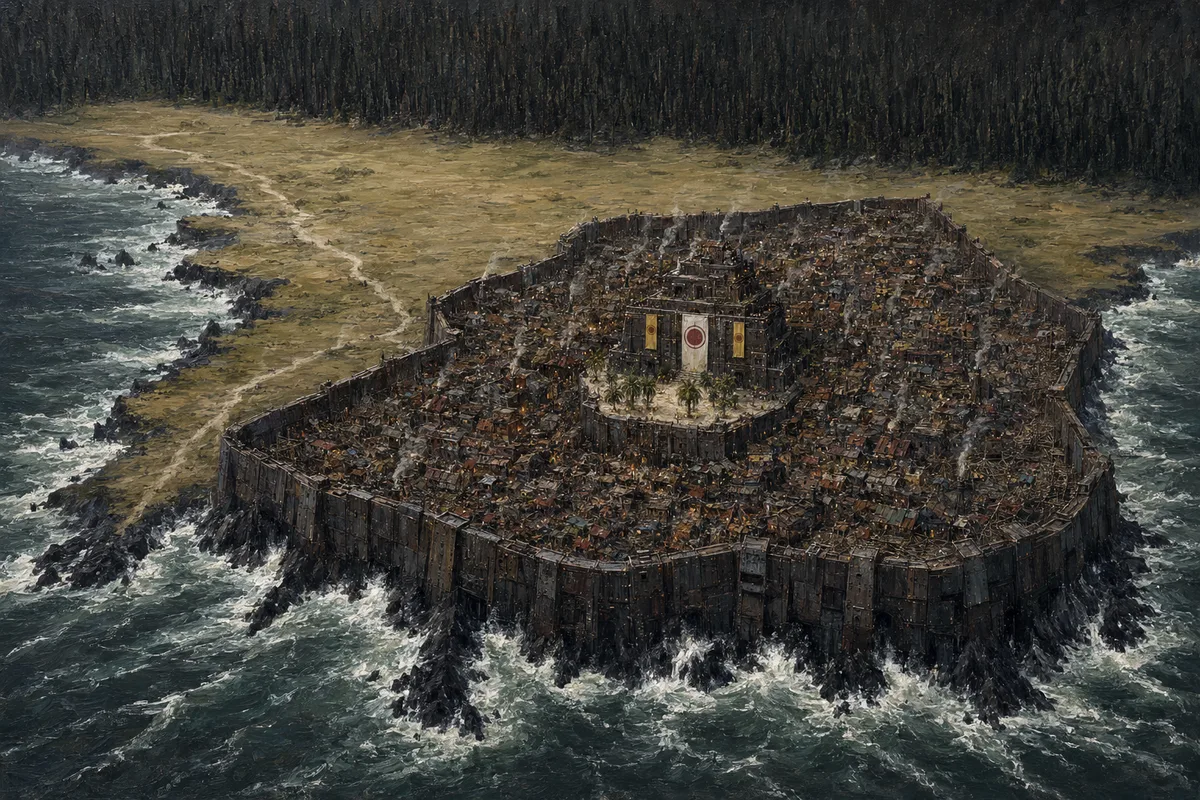
On the south-eastern coast of Tuith, the Forests of Aranyel come down toward the sea and stop short of it. Between the last of the trees and the cliffs lies a stretch of bare ground. The Shira count it as theirs, as they count all of that coast, but they have never had a use for it. They keep to the shelter of the forest and do not willingly come out from under it. On the maps I learned from as a boy, the green of their country runs unbroken to the water, and that bare ground is not marked at all, because no one had thought it worth marking.
It is marked now. There is a city on it, behind a wall of metal so high that those who have passed that coast on the Turtle speak of it before they speak of anything else. The people who built it came from across the Wild Sea, and they called it Hursts.
In the tongue of Aur, I am told, the word means a port, or a harbour. It lies close enough to their word for pain that the settlers heard both in it, and thought the second as fitting as the first, given what they had left behind them. The first has worn less well. Hursts stands on high rock, and the currents of the Wild Sea come against the foot of it without rest. What anchorage it has is poor and dangerous. There are no great harbours anywhere on Tuith, because there is no shipping on the open sea that would need one. What boats we have keep close to the coasts, since the Wild Sea and the Turtle’s circuit between them have made the open water all but impassable. The name is one the settlers brought from a country that had harbours, and the ships to fill them.
Most of what I know of the place has reached me at second or third hand. In fifty years people have gone out of Hursts as people go out of anywhere, and not all who crossed the sea ever meant to stop there. Some went on west, by the Turtle or by the coastline round the forests, and settled where they could: in Dondotha, in Pax, in Byercet. There are enough of them in our cities now that no one turns in the street to look, and I have sat at more than one of their tables. The first I ever met was an old man who mended clocks, and he would not speak of the crossing at all. Others have spoken of little else.
The rest has come from traders of the Turtle, which passes that coast on every circuit, and from Aurians who live on the Turtle’s back now and remember the crossing or had it from their parents. And lately some has come from men who carry cargo to the city and would rather not say what the cargo is. They do not always agree, and none of them is a disinterested witness.
Across the Wild Sea
Some seventy years ago the revolutions began across the Wild Sea, in the country we have learnt to call Greater Aur. The name belongs to Aur, the oldest and strongest of the kingdoms on that shore, and not all of its neighbours thank it for the honour. The names of the others came west with the settlers, and fifty years have made them common enough in our markets: Borea in the northern uplands, Serrun in its valleys, Ulan in the broad country inland, Vaska on its southern rivers, Ossea on the western coast. We call everyone who comes from over there an Aurian. Most of them are nothing of the kind, and some will tell you so sharply.
The revolutions began, by most accounts, among the scholars of Serrun, and they went hardest in the south. Borea, in the north, lay nearer to Aur and leaned on it, and kept its throne. The southern crowns fell outright. Serrun is gone altogether, swallowed by Ulan, which calls itself Greater Ulan now. The name was chosen, I am told, to offend the older one. Vaska and Ossea lost their kings and have made what they could of what came after. And the states that rose in the south carried the revolutions’ hatred of mages as far as it would go, past suspicion and past restriction, to the hunt.
For a mage of the south there was nowhere left to stand. Northward, the crowns that had kept their thrones had little more love for mages than the new states had, and would give them no shelter. Eastward, beyond Aur, lies Hoq, which the Aurians describe as a country of fire, where the Ifmari fight one another under the shadow of dragons; no Aurian I have met would go there for any reason. That left the west, and the west was the Wild Sea.
No one sails the Wild Sea. Before the refugees, no one had ever crossed it, so far as either shore remembers, and on both it is reckoned a way of dying rather than a way of going anywhere. The waters on our side of it have been quieter for centuries, since the Shira raised the first of their pyramids at Althuz, but quieter is not quiet. The southerners put out into it regardless. There were mages among them, and it is said their power brought some boats through that would not otherwise have lived. But most of those who went were no mages at all. They were families, traders, labourers, men who had fought for the old crowns and men who had fought against them, and what carried them was chiefly that they had nowhere else to go.
Most of those who reached Hursts, by what I have been told, were of Ulan and of what had been Serrun. They came down through Vaska and Ossea, and drew a good many of both countries’ people after them. Many put out, it is said, from the Ossean coast. Boats went in numbers and were lost in numbers. I have never heard a count of them, and none of the Aurians I have asked offers one.
They cannot have known much of where they were going. For as long as any record of ours runs, their country and ours have been closed to one another by that sea. There were always stories on this side of it of a far country of many kingdoms, but they came ashore with the pirates of the Turtle and were given the credit pirates’ stories are given. I heard them as a boy, and was told to put them with the sea-serpents. Now any market porter in Pax can tell you Vaska from Borea. The sea-serpents are where they were. The Aurians, it seems, knew as little of us. They believed there was land to the west. Of who lived on it they knew next to nothing.
They learnt quickly enough that someone did. Those who lived through the crossing came in some fifty years ago below the forests, where the currents and their own failing boats allowed, and the Shira were at them before they had made land. Some of those boats never reached the rocks. Who it was that struck at them, the newcomers can hardly have known. That they were not wanted, they could not have missed.
What came next, the Aurians tell much alike. Once the refugees were ashore, the Shira held back, as though they had not decided what to do with them. It was not long, but it was long enough. The mages took the boats that had brought them over, broke them for their iron, and raised walls out of it, and the walls were standing before the Shira had made up their minds. They are metal, raised by spell rather than by labour, by every account I have, and they are spoken of as a marvel of magic wherever they are spoken of at all. The people behind them had crossed that sea, and they were not going to cross it again.
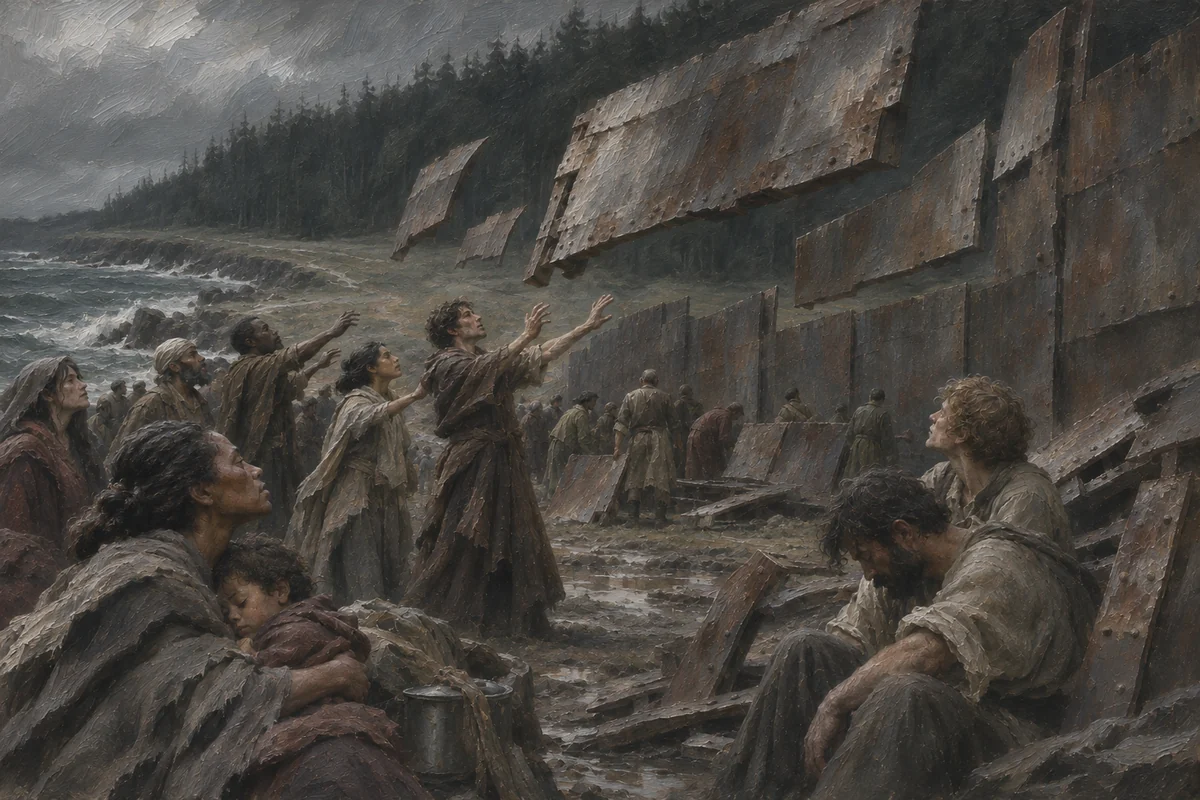
The revolutions did not stay in the south. In time they moved north, toward Aur itself.
Some word of Hursts had gone back across the sea by then. How it went I have never learned; the Wild Sea carries few messages, and fewer still in that direction. Whatever reached Aur was hearsay, and likely hearsay of hearsay, but it said that the refugees had found land in the west and were holding it.
That was enough. The royal house believed the revolutions were at its gates and might have the crown off it within the year, and it had reason to believe it. In that fear it resolved to follow where the refugees had gone. It looked for country it could be surer was empty, and settled on the White Mountains, far to the north of Hursts. One of the royal blood led the crossing in person.
It was better supplied than any refugee boat, and it suffered worse on the sea than the refugees had. What survived of it built the Chalk Towns, a breakaway from the very crown that had sent it, and they will have their own account in this volume.
As it turned out, the revolutions did not take the crown of Aur that year, nor have they since. Of all the crowns there had been across the sea, only Aur’s and Borea’s are crowns still.
Three Years at the Walls
The Shira did not, at first, look to anyone for help. Whatever use they had or had not made of the bare ground below their trees, they would not have men on it, and they meant to put the men off it themselves. For the first time in their history they declared war.
They had never made war on anyone. The nearest they had come was among themselves, when the Grove Worshippers raised defences in the deep forest; that had lasted four months and cost some three hundred lives, and they had counted it a catastrophe ever since. For the rest of their long history their warriors had been a caste of ceremony. They had never besieged anything, and no one had ever taught them how. They brought several thousand of those warriors to Hursts, with mages behind them, and for three years they came at the walls.
On the walls stood people who had just crossed the Wild Sea to be there. They were running from revolutions that would have killed them, and they had nowhere left to run. They had rifles, and spears where the rifles failed, and the height of those walls under their feet, and among them the exiled mages who had raised the walls in the first place. The walls held.
Before the first year of it was out, the Chalk Towns had risen in the mountains. The Shira counted the White Mountains part of their greater country, or at the least a country no one was to settle. But they had one war already, and did not march on the mountains to begin a second.
In the end the Shira could do nothing more at the walls, so they went to the sea. Their mages learned to find boats far out on the water, and what boats still came across after the first landings went down before they sighted the coast. Whether anyone on the far side judged the road not worth the cost, or there was simply no one left who would attempt it, I cannot say. After a while no more came.
When the three years were out and the walls still stood, the Shira tried to get by letters what they had not been able to take by force, and did a thing they had never done. They wrote to the old kingdoms of men in the west, asking for their voices against any further settling by the Aurians, and for their arms, if arms could be had, to put the settlers off the ground they already held. In return they offered a pact of mutual defence. The letters were in our own speech, and those who read them say it was handled better than most of our clerks could manage, by a people who had kept their borders shut against us for longer than anyone can reckon.
Neither kingdom took up the offer, and the reasons are not hard to find. Ursul sat on the throne of Pax then, and he and Byercet were still at the war they had been fighting for a thousand years. No one at either court could see the sense in taking up a second while the first had them by the throat. Nor would either crown take the Shira’s part against men; the Shira have never in all our history been friends to men, and a pact of defence with them was a promise no king could be sure of holding them to. And the settlers’ weapons and engines had already begun to find their way west, to both kingdoms, as gifts as often as in trade, and each court was coming to lean on them more with every season. Neither king was going to make war on the men who were arming him.
The refusal did not close the forest to the courts of men for good. The Shira had learned that letters could go where warriors could not.
Those same weapons, it is said now, had their part in ending the old war. With them a war that had been ruinous for a thousand years became one that neither kingdom might survive. Four years after the Shira’s letters, Ursul died, and his son Rolan came to the throne of Pax and sat down with Byercet to talk of peace. Three years after that the peace was made. How much the settlers’ engines had to do with it, men in both kingdoms argue still. That they had something to do with it, few deny.
Between the Shira and Hursts, no peace was made. Neither side has ever said the war is over. The Shira did not take the city, and each has let the matter rest there without a word passing between them.
What Hursts had after that was what it had already: its walls, its people, the engines it had carried over, and what could be made with them. It has lived most of its life since on a coast that would rather it were not there, with no city of men anywhere near it, feeding and arming and mending itself alone.
The Founders’ Kind
Mages had brought Hursts over the sea, and mages had raised its walls, and Hursts did not keep them.
The revolutions had not been left on the far shore. Their quarrel with mages had been soaking into the south for twenty years before the boats ever sailed. The refugees had lived inside that quarrel and carried it with them without meaning to. While the Shira were at the walls, the mages were needed, and they were suffered. Once the fighting stopped, and the crossings with it, the old fear had time to fester, and it did. In time Hursts outlawed its mages. The Chalk Towns in the mountains had done the same from the first. Those who got out alive went to the Turtle. How many did not get out, no one has told me.
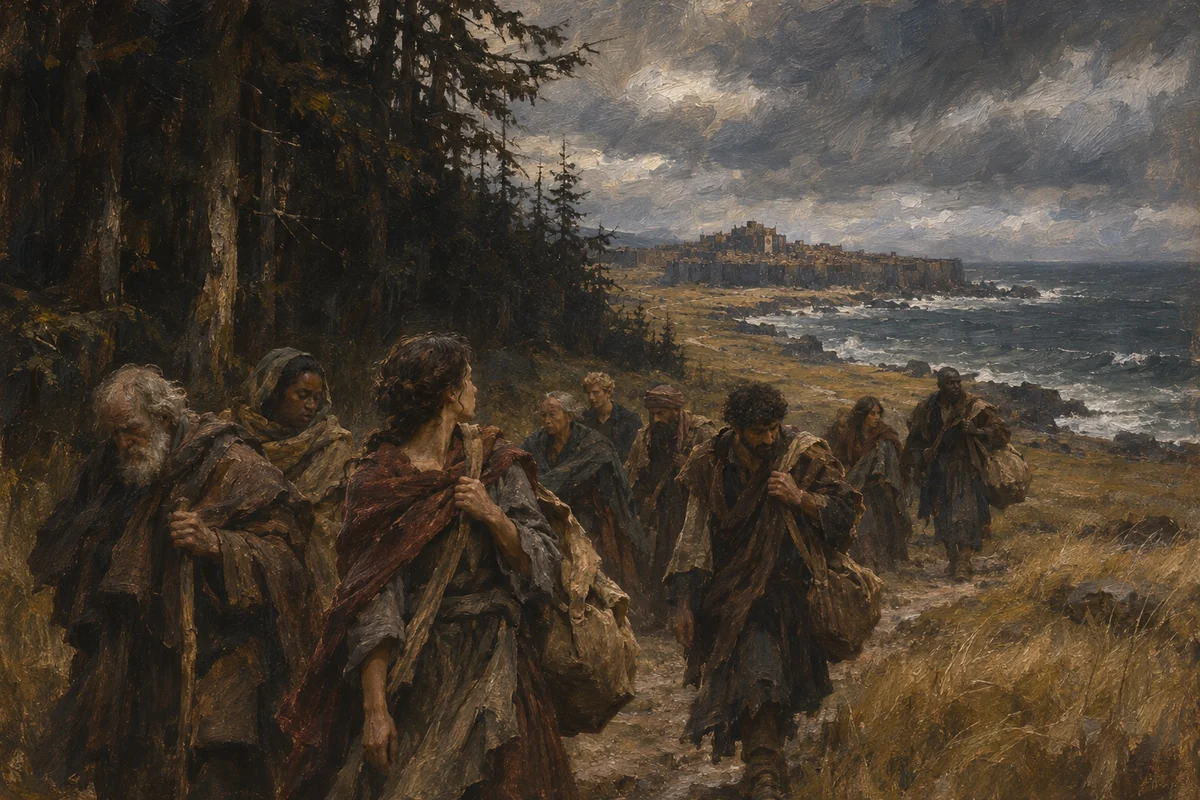
It could not have been done without the stingers. Among what the refugees had carried across were machines made in their own countries for the hunting of mages, and near one of them an unprepared mage has no more power than the man standing beside him. That people running from the hunt should have packed the hunters’ tools is less strange than it sounds. They took whatever they could carry that might keep them alive, and they had seen at close quarters what a mage can do. Some of those machines came west afterwards in trade, to Pax and to Byercet both, until the two crowns outlawed them in the terms of their peace. In Hursts no one outlawed them. They are why Hursts had nothing to fear from the mages it put out. Those mages are on the Turtle still, or their children are, and the Turtle passes Hursts on every circuit. They have not come back for the city. Under those walls they would have nothing in their hands.
To one raised in Byercet, where all magic outside the Hooded Drogynor’s hand is forbidden, the law itself is no great wonder. What it cost the city is another matter. The law brought Hursts nearer to ruin than three years of the Shira’s siege had, and what the law began, the pirates helped to finish.
The Convention
The pirates had found Hursts almost from the first. The Turtle’s circuit carries it past every coast of Tuith, and a city on the sea cannot hide from anything that passes it as often as that. They went first for what boats Hursts could put on the water, few as they were and close as they kept to the shore: the supply that went north to the Chalk Towns, the trade toward Byercet and along the Shira’s coast. Then they came in across the rocks to the city’s own poor anchorage. Hursts had rifles and walls. It had no navy, and a wall is no help to a boat tied up at the foot of it. The raids came on year after year, and did not let up.
What checked them came off the Turtle itself. There were Aurians living on its back by then, some of whom had crossed the sea with the people now being raided, and they had given the Turtle designs from their own country that the island had come to rely on. They asked the council to forbid the raids outright, and were refused, for on the Turtle no faction may tell another what it may do. But what they had given could be bargained with, and on the strength of it they won a convention. Military targets and trading ones might be struck. The houses of the city might not. No Aurian settler was to be carried off as a slave. And no raider was to touch the works that bring Hursts its water and its power, whose designs the Turtle had long since taken for its own use. The Turtle has no law to bind a captain by, only what is said of him in council afterwards. That has been enough. I have not heard of the convention being broken, though I am not sure I would.
A King in Hursts
Between the law and the raids, the city could not prosper. Decades of pressure strangled what trade it had. Money that might have been put into the place went elsewhere. The council that governed the settlers lost what standing it had with them, and into the room it left came the men who could fill it: strongmen first, and after them criminals, and I am not certain anyone in Hursts could tell you where the one became the other.
One of them was Jankos. He was already a power in the lower streets when the settlers’ government broke, a generation ago, and his men held the city’s gates long before he held anything else. For twenty years after that he was one power among several, in a city with no master. Seven years ago he named himself king, and he has ruled Hursts since. His name is known to every court and realm that has had dealings with the city, since for seven years there has been no one else there to deal with. He is spoken of as a king, and as nothing better than a gangster, often by the same men in the same breath.
That King Jankos keeps a mage is less widely known. I came to it slowly, and not from any envoy. It reached me first as a passing remark from a man who had carried cargo to the city off the Turtle, that there was someone at the king’s elbow almost all of the time. Over the following years it came to me again, told differently, from others who had no reason to know the first man or each other. I believe it now. In a city that drove out its mages and keeps engines against them, I have found no one who can tell me whether the law was set aside for this one, or the engines, or both. It is said the mage came off the Turtle. That is likely. I cannot say it is so.
As It Stands
Since Jankos took the city, more trade has come into Hursts off the Turtle than ever came before, and less of it is the kind an honest market would take. In the last two or three years the envoys have gone home, and almost no kingdom keeps regular dealings with the place now. The western kingdoms are forty years into a peace after a thousand years of war, and show no wish to be drawn into anyone else’s. The Shira have watched Hursts from the trees since the first wall went up, and what they mean by it they have told no one.
From the mountains come rumours of mobilisation. Some say King Clement of the Chalk Towns means to take Hursts, put the coast back in order and shut the trade that runs through it to the Turtle. Others say, as I set down in my account of Aur, that his army is meant for the sea, and for the old country on the other side of it. I have heard both from men I would ordinarily trust, and I have not been able to choose between them.
Under all of it runs the word from Aur, which I have set down already in its own place. It came as such word always comes, late and worn and through more hands than I can count, by the Turtle and among the Aurians who live with us: that the people of the city stopped where they stood, that armoured columns passed in at gates no one closed, that the few vessels to go near that coast since have found it silent. I have not been able to test any of it, and nothing newer has come. The old clockmender, who would never speak of the crossing, raised it with me himself, and asked whether I had heard anything more. I had not.
Aur kept its crown when the south lost every one of theirs. It feared for that crown enough to send its own blood over the Wild Sea against the day the revolutions reached its gates, and they never reached them. What reached them instead, whose the columns were, and what has become of the people inside, no one I have asked has been able to tell me.
I have recorded these things in the order they reached me, each from men who did not know the others: a city that has lost its friends, a king in the mountains whose army might face either way, a crown across the sea that has gone quiet. I do not know yet whether they belong together. I am beginning to think they do, and I would rather not.