The kingdoms have a great deal to say about the Shira, and almost none of it from standing in front of one. They are the oldest neighbour men have, and the only one whose door has never once opened to us — not from aloofness, as I once took it, but from design. The Shira do not merely withdraw into their forest. They keep the rest of us out of it, and where keeping us out has meant drowning a crew in the Jade or leaving them to starve on a shore, they have done so without apparent regret, for longer than Byercet has kept records.
What follows rests more than I would like on the word of men I cannot check — a trader’s bargain remembered years after the fact, a soldier’s account of an enemy he saw only in the dark, a single Shira voice set down at second remove. I will say as I go whose hand each thing comes from. A careful scholar should know the difference between a thing glimpsed in passing from the Turtle and a thing sworn by a drunk on its docks — even where both, in the end, turn out to be true.
What Can Be Seen
The plainest facts are the oldest, because they can be had at a distance, and distance is all the Shira have ever allowed. East and south of the Jade River stands a forest without visible end. From the water it offers nothing anyone would call a harbour — no docks, no seawalls, no smoke of forge or kiln, no lamplight.
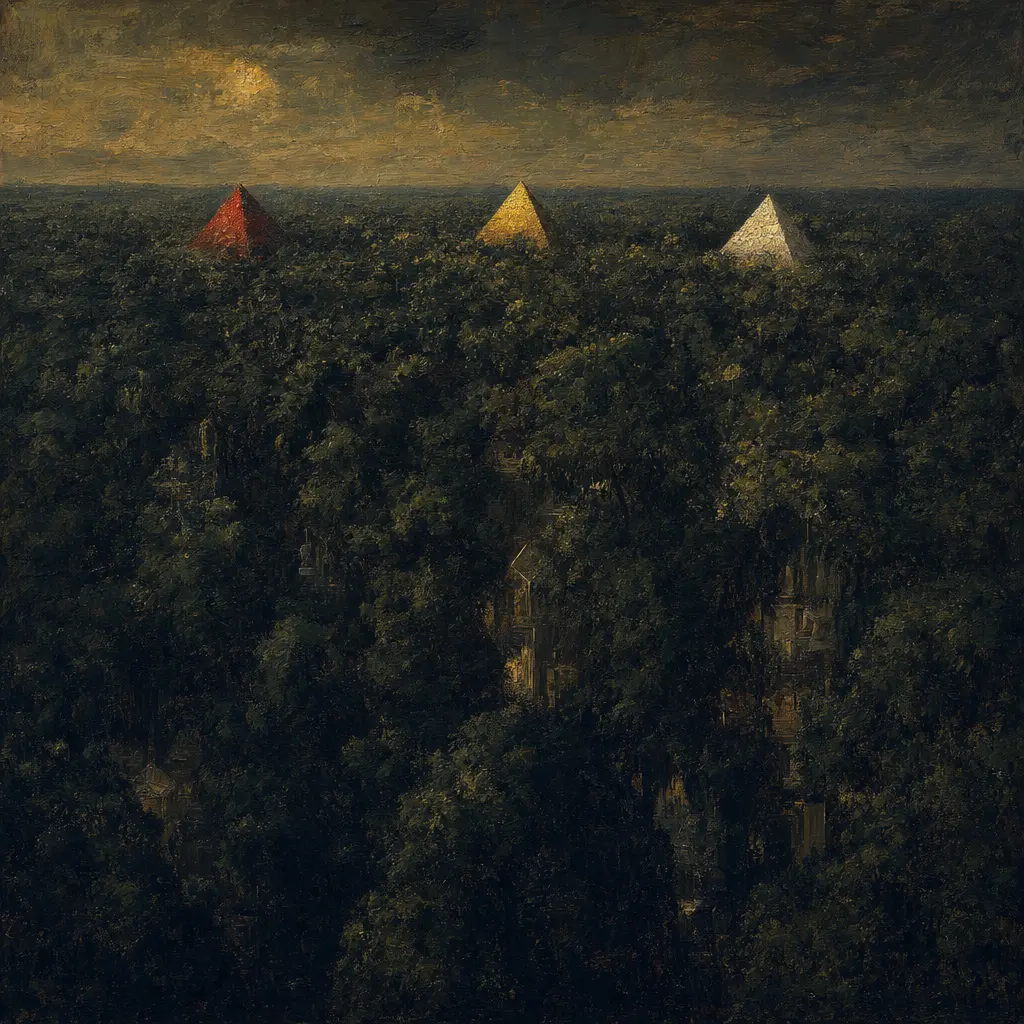
Two things only, on that whole coast, declare that anyone lives behind the trees. The first stands plain in daylight: three pyramids in the north-east, rising above the canopy within sight of the sea — one white, one gold, one red, vast and ancient and plainly the work of no common hands. The city they must crown no man has seen; the Shira are said to name it Althuz, and the name is the whole of what we have of it. The pyramids themselves the Turtle shows afresh to all it carries, each pass along that shore, and they do not vary in the telling.
The second sign shows only at night, and only on some — a faint cold glow, with no fire in it, that threads through the dark of the forest and is gone. What either is for, no one can say. I will come back to the glow, for it is the more unaccountable.
To the west and north the forest ends at the Jade, and the Jade is not crossed. It is held bank to bank by the river-people, the Niru, who pull under whoever tries the water without leave. That is the whole of our dealing with the Shira’s border: a river we do not cross, a coast we cannot land on, and a city we may look at and not enter.
For the sea will not have us either. Between the pull of the two moons and the Turtle’s endless circuit, the open water around Tuith runs in currents that have drowned more ships than the Shira ever did. No kingdom of Tuith has built a navy worth the name, because the sea will not abide one. To reach that forest by water, one must make terms with the only thing that crosses it freely, and that is the Turtle.
Born of the Trees
Here the traders of the Turtle earn their place, for they have done the one thing no kingdom has managed. In the hours the creature runs nearest the eastern shore they have traded with the forest — goods passed at the waterline, the Turtle borne on again before the tide turns. No one steps off. But a bargain struck across the same stretch of water for generations teaches a people something of those across from it, and what the traders have learned, before anything else, is this: the Shira are not born.
They are not born, and they do not breed. A Shira comes from a tree. In the groves stand the Mim — great trees the Shira revere as a devout man reveres a temple — and from the Mim the Shira come, as infants, in the open, in the ordinary course of an afternoon. The traders hold that the markings of what the child will be are already on it when it is lifted: the farmer, the warrior, the worker, the priest.
I set this down as the traders give it, and I will not pretend I know what to make of it. It is the strangest thing the kingdoms half-know of any people, and it is sworn to by men with no reason to invent it and every reason to keep their dealings quiet. Of late, they add, the Shira seem quieter and more solemn than the older among them remember. Some say something ails the Shira that they will not tell, and we may not know.
At the Waterline
What can be seen of a Shira is seen at that same waterline, and the traders agree on the look of them even where they agree on nothing else. They are people, after a fashion — they go upright, they wear clothing, their fighters go in armour — but no trader has ever taken one for a man. Their skin is bark: dark and coarse as old oak in some, pale and smooth as birch in others, all of it veined over in faint lines like the underside of a leaf. From the brow grows living wood, a knuckled stub in some and a full spread like antler in others, and through their hair grow sparse green leaves that they work into their braids. They go barefoot in any season. And the eyes are colours men do not come in, so that a trader who has dealt with the same Shira for thirty years will tell you, and mean it, that he has never once felt he bargained with an equal, but with something older and other that had agreed, for the morning, to do business.
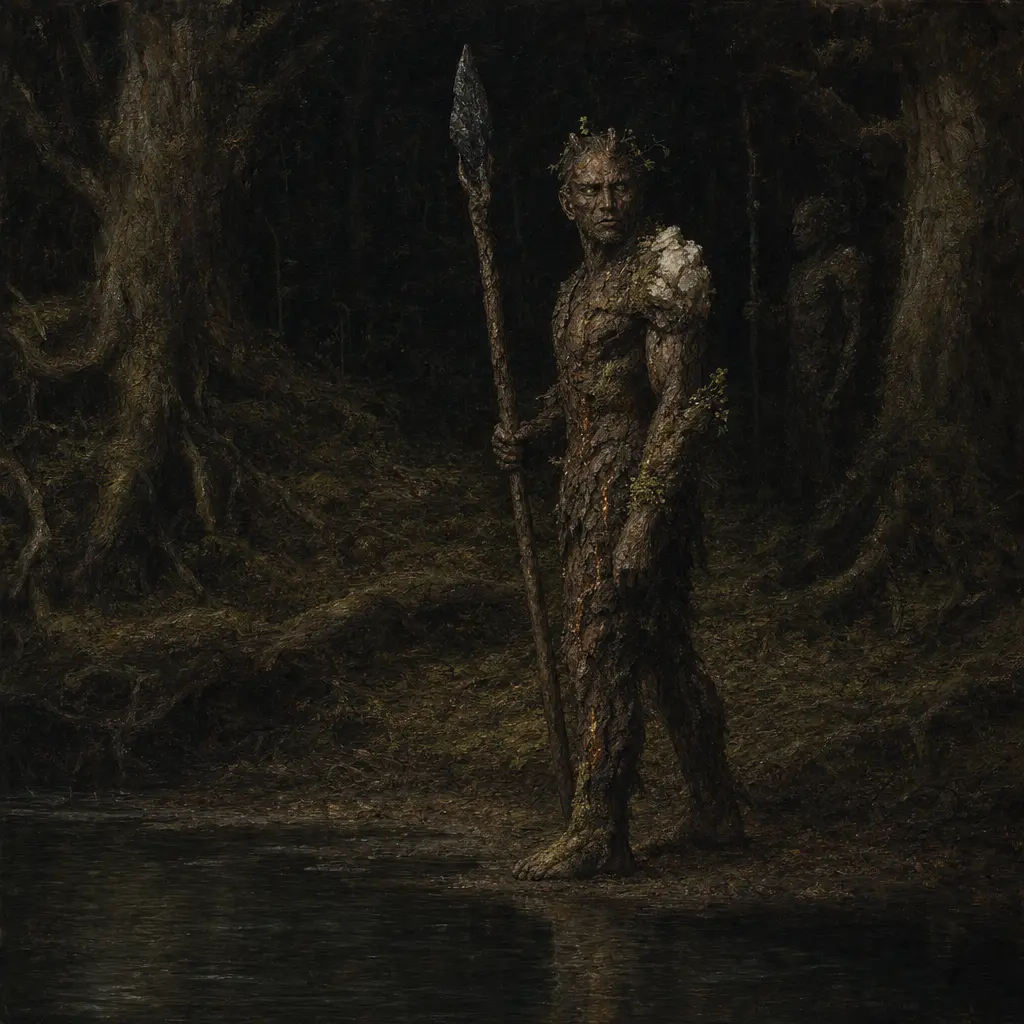
They hold the Mim in a reverence that unsettles the few who claim to have watched it — attending the trees, singing to them, gathering before them when a matter carries weight. What the trees are to them, they will not say. The asking, more than one trader reports, is not welcomed twice.
The price of all this knowledge is that the sea grants only one passage. The Turtle’s wake throws whatever leaves it in toward the land, and nothing the sea offers will carry it back out against the pull. To reach the forest is to be stranded on it. Devran Orth, one of the minor lords the Turtle has raised in its restless ages, proved as much four centuries past, in the one such venture the records name.
He travelled from the Turtle to the shore with thirty of his men — as many as the crossing would bear — went up the beach toward the trees, and was met there by the Shira, who would neither let him pass nor let him stay. He could not regain the Turtle. What became of Orth and his thirty is known at all only because the traders watched from the deck as the creature bore them away — and what they saw, they did not all tell the same, and none of it was good. No one has tried it since.
The Iron City by the Sea
For anything that happens behind the trees rather than at the waterline, the kingdoms long had nothing — until, half a century ago, the trees acquired a neighbour who could not look away. Men fleeing the ruin of their own country across the Wild Sea built a city from the scrap they had arrived on, raising it on the southern tip of the forest, in a stretch the Shira held thinly, and named it Hursts.
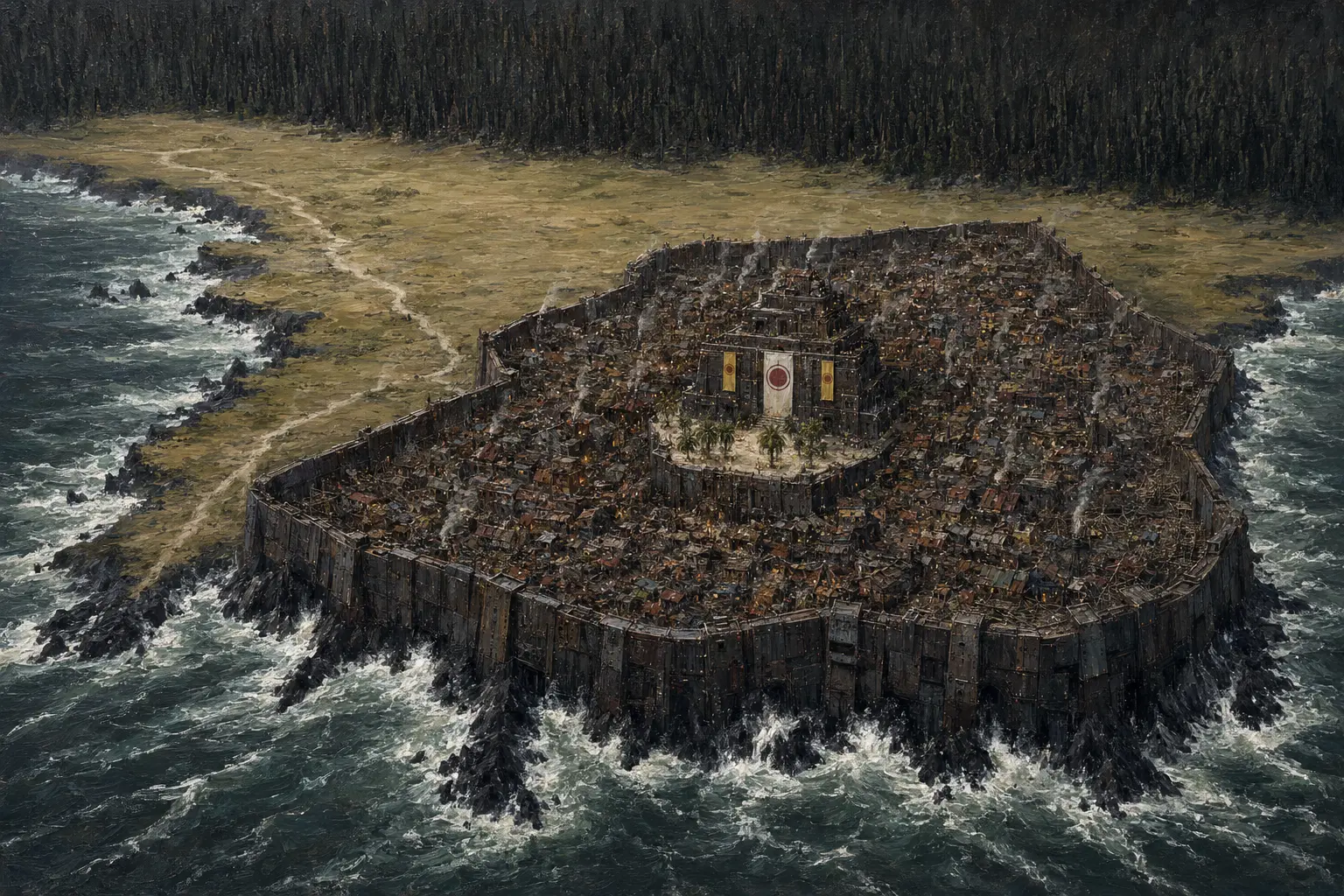
That they made it across the sea at all was a miracle, bought with countless lives lost in the crossings. That they built a city that endured is an altogether greater feat. The Shira took issue with it from the start, but the skirmishes that followed they could not win, and it never came to open war. Instead it settled, sourly, into the hard silence they seem always to prefer.
It is said they could not throw down the walls — colossal, and of metal, and likely the work of Aur’s fugitive mages, the last of a craft put to the sword in the chaos that drove them here. Thanks to those walls Hursts stands yet, fortified and strong. But its people live within sight of that treeline, and have had to learn the Shira the way one learns a thing that can kill them. Much of the newest matter in this account is theirs, paid for in a coin they would not have chosen.
The Four Orders
What a Shira is born to, it remains. They are divided into four orders, and a Shira moves between them no more freely than a hand moves between its own two halves. There are the farmers, who tend the forest and its long rhythms; the workers, who build; the warriors, who fight; and the priests, who keep the Mim.
The settlers at Hursts add what the traders could not: that the Shira’s magic is no distant wonder-working. It lights and warms their settlements, shapes both stone and blade, mends the hurt, and carries word across distances no rider could ride. The defenders of Hursts, who have met it only as a weapon, describe it as one. But those among them who have watched longer report something they had not thought to find: that the Shira seem to pray over the work, that the lighting of a path at dusk is done with a gravity another people would keep for an altar.
Over the four orders, it is said, sits a council drawn from each, and which order leads it shifts with the age — the farmers in quiet times, others when the times are not quiet. By every account that reaches me, the times are not quiet now, and it is the priests who lead.
The Pale Paths
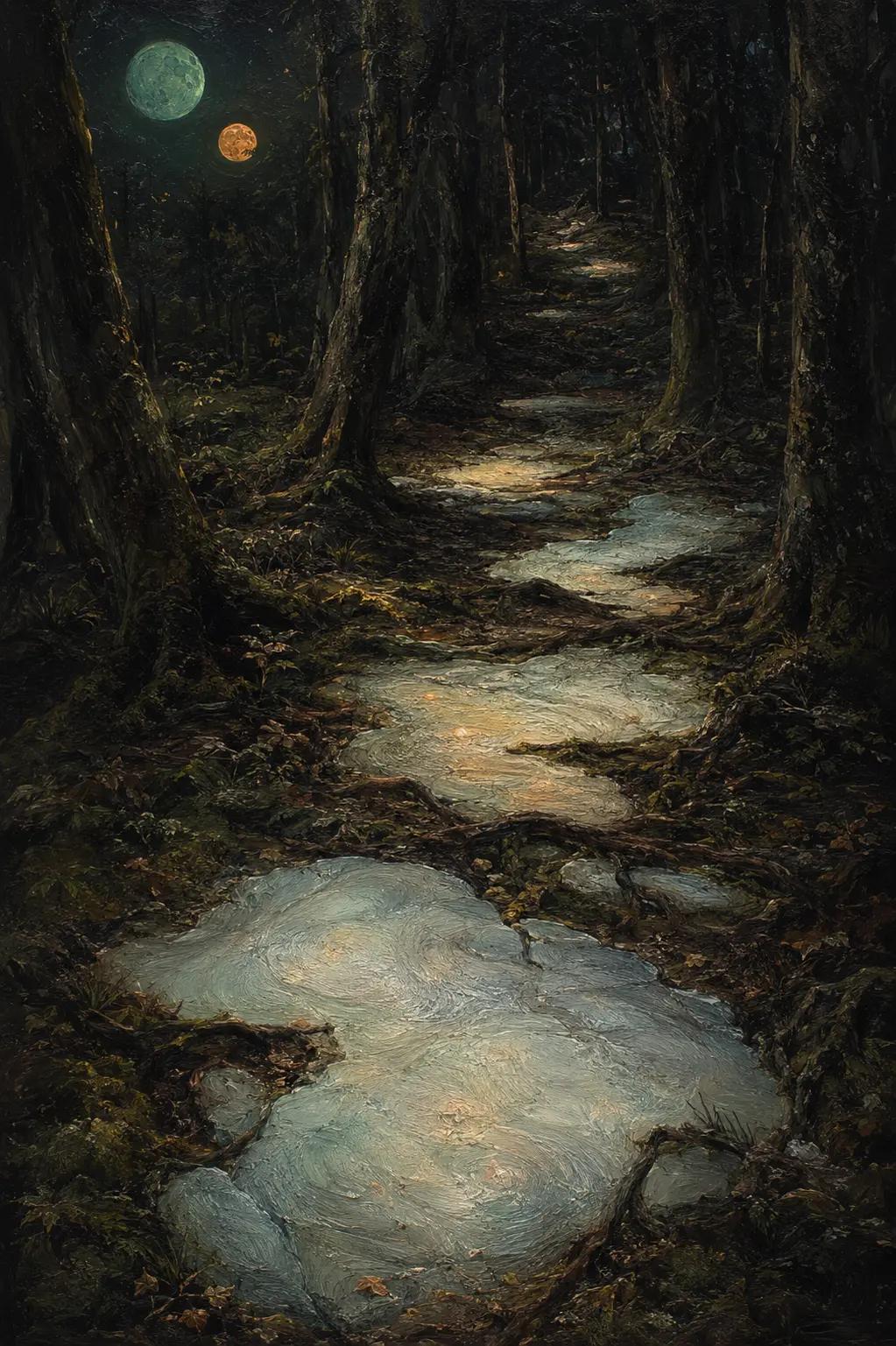
I promised to come back to that glow in the trees — the cold light, with no fire in it, that shows from the sea on certain nights. It has an explanation, of a kind, and it is Hursts that comes nearest to giving it. The traders see it only from the water, half-glimpsed and easily doubted; the watchers on the walls see it better. Through the forest run broken paths of pale stone, all but invisible by day. But under certain alignments of the two moons the stone wakes with an inner light — a silver wash on some nights, on others a luminosity that snakes through the trees in a dazzling maze. From passing it is the faint glow the old hands vouch for; from the walls it is a map laid across the forest floor. They have learned to say nothing of it. What the paths are for has not been discovered by men, and the Shira have not told.
What Older Tongues Carry
Of where they came from there are fragments, at the same long remove, of what the Shira believe: that the world was struck, in an age before men, by a burning stone fallen out of the sky into the sea; that where it struck, the water was thrown back and land rose in its place; that from the land grew the trees, and from the trees came the Shira.
The mer, whose memory runs longest of all, are said to keep the same account of the blow: that it threw down a great part of their own deep cities and set them rebuilding for generations. Two peoples who agree with no one, agreeing with each other upon the same catastrophe, is rare enough that I credit, at the least, the fall.
They say too that the first Shira came as infants, as they still come, and that the trees themselves raised them — taught them speech, and the drawing of magic from the earth, and the dividing of the people into four orders — and then fell silent, and have not spoken since. There is an old word among them that the trees will one day speak again. When, the saying does not give. I set it down as I have the rest of it, a rumour of a rumour, and pass on.
So that is the outward shape of them, and I have set it down first because it is the surest part. One ought to know the coast of a country before presuming to chart its interior — and the interior of this one is precisely what no man has been allowed. What I have of it is scantier, and darker, and I will set it down where the sources let me, in the chapters that come after this one: the three kings they are said to have raised and unmade, the older catastrophe the mer and the Shira alike remember, the question of what quiet has come over the Shira of late. Here I have kept to what can be seen, because it can at least be sworn to. And even of that, through all of it, they have told us almost nothing of themselves they were not forced to.
There is one thing they are said to have spoken, though, and I will close on it, for I cannot quite put it down. At Byercetra, one evening at dusk, King Nibūna the Lost is said to have stood for his portrait on the bank of the Jade, and seen a Shira on the far side watching him across the water. It is written in many places that he swore until the end he heard it speak, in plain Byercetian, four words and no more: We wait for her.
Mothers have frightened their children off the river with worse versions for as long as anyone remembers, and most of those are plainly invention. But the four words never change in the telling. Who it is they wait for, behind that treeline, after so long, I cannot say. I am only certain they have not stopped.