In the first part of this account I kept to what can be seen of the Shira: their coast, the trees they come from, the four orders and the pale paths. I ended with the pyramids of Althuz. That was the outside of them.
Generations ago, a Byercetian scholar called Osric of Byercetra claimed to have spoken at length with a Shira, the only such conversation on record before or since. More cautious scholars have long agreed that this was probably an embellishment. More likely, Osric gathered fragments of Shira texts that had found their way into the realms of men over the centuries: a copied verse here, a translation there. From these he compiled his account in the form of a conversation.
The distinction matters less than it once did. The few fragments studied and made public since confirm the broad strokes of what Osric wrote. Nearly everything below that speaks from inside the forest is from his pages: one man’s compilation, drawn from scattered sources long ago. Later discoveries have borne him out on the broad outline: certain kings reigned, certain quarrels divided the people, the mer came ashore and were later refused. But where he reports private motives, exact speeches or what passed in someone’s final night, the reader should remember that no second witness has come forward.
The Tongue of the Trees
Asked what they have made in the world, the Shira are said to name their language before their pyramids. It is called Anmire. By Osric’s account it is older and more finely built than any tongue of men. Its vocabulary is vast, its grammar exact. Its poetry runs back three ages, and the Shira count that poetry as the truest monument they have.
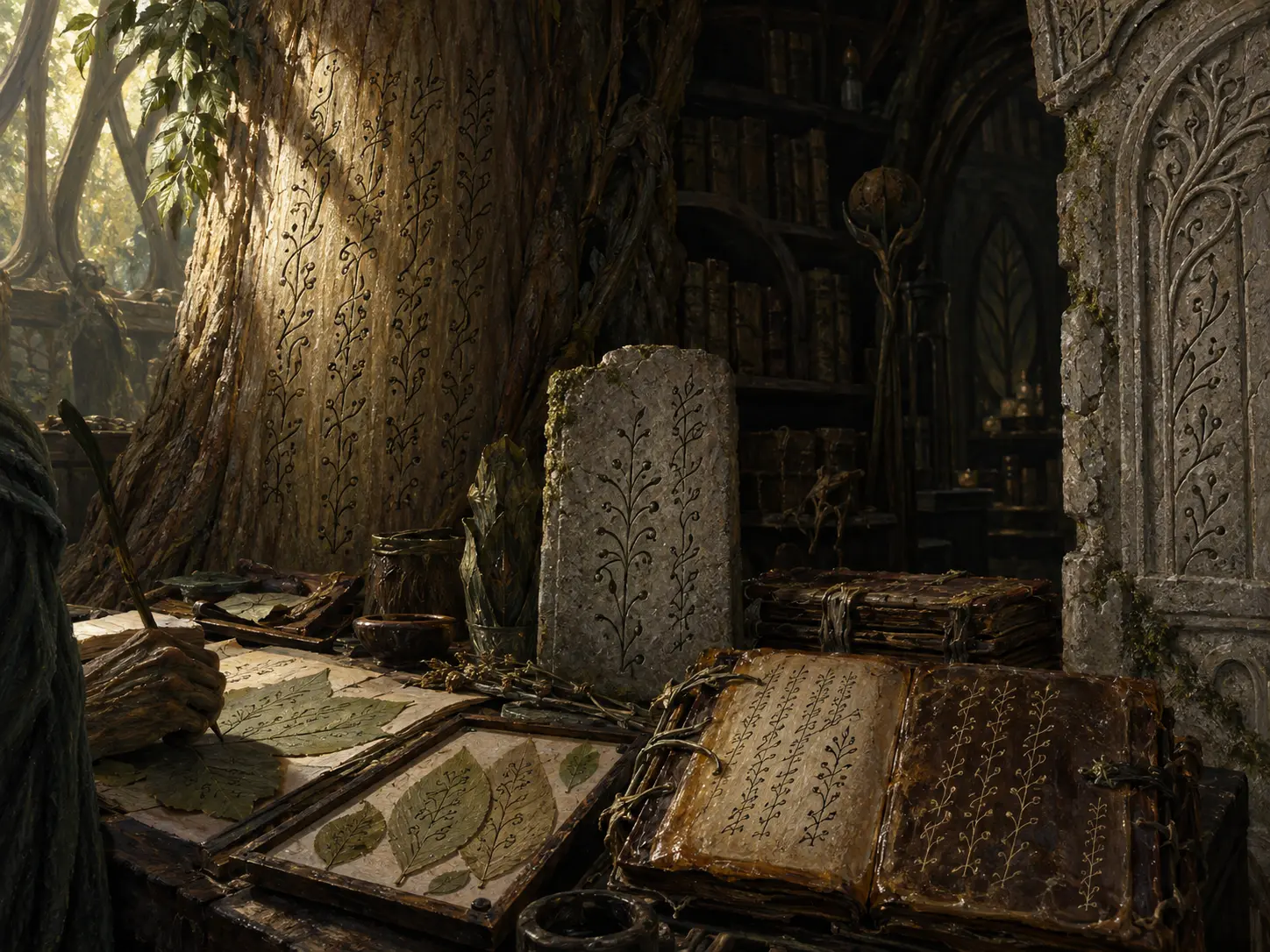
They do not write it as men write. The script shows rather than sounds. Each character is grown from a shape in the forest — the veins of a leaf, the branching of a root, the curl of a new shoot. Children are taught the hand from their earliest years, and to write it well is counted a vocation in itself. I sat as a boy under the clerks of Byercetra, for whom copying was a penance and nothing more. I have never quite known what to make of a people who made it a calling.
They keep their writings in leaf-pressings and in codices bound in resin, storing them in the bark of living trees, some of which have carried the same words for centuries. They cut them into the stone of the doorways of the public buildings in Althuz. There are several libraries in that city, and a smaller one in every settlement of any size. The great works are known by name even where they are not read: the Meditations of Othmir, the Seven Songs of the Grove, the River Cycles and the mathematics of Sabrun. There are philosophical dialogues from the early schools, and chronicles kept without a break since the Shira first learned to write.
No scholar of ours has read more than fragments. But more has come out of the forests than their closed borders would suggest. A trader carries away a verse; a passage survives in translation; a leaf-pressing turns up in a lord’s hall and no one can say how it came to be there. It is among the few things of the Shira the kingdoms can be said to own, and it is the well from which most of our knowledge of them has been drawn for centuries. A people who can keep a border shut for an age could keep a library shut as easily. Whether they let these pieces go, or only failed to stop them, I cannot say. I have my suspicion, and I will leave it at that.
The Shira were born out of the Mim trees at the close of one age and spent the whole of the next becoming what they are. Osric reckons it at some two thousand years, and the Shira call it the age of formation. In it the four orders settled into their places. The first villages rose. The language and its script came to their full growth. And the teaching of the priests on the Mim grew from something young into something settled.
It was, for the most part, a peaceful age. The Shira had no enemies outside the forest. But three quarrels inside it went deep enough that they are still named, and Osric set down all three.
Three Kings
The Shira inherited from their earliest days a prohibition against kingship, later set down formally by a priest called Kalin as part of a prophecy of which more in its place. The prohibition itself was absolute. Twice, before Kalin’s hand ever fixed it in writing, the Shira tried kingship regardless, and both times it broke them. A third attempt came later, after the words had been written.
The first began some four centuries after the Shira’s birth. A warrior-mage called Uthmir rose above every other of his generation, both in skill and in the love he inspired. A circle of his admirers, most of them warriors, proclaimed him king. The Shira had never had one. The elders divided over it: some thought it a natural growth, others a grave error. Uthmir took the title.
He reigned eleven years. He was killed in his own hall by a mage of the priests’ council, who said afterward that the Mim had spoken to her and told her to end it. No one could test the claim. The trees had been silent for centuries by then. She was tried and put to death. Uthmir’s court was gone within the week, and no one proposed a successor.
Some three centuries later a priest-mage called Halûn gathered the same kind of following and was crowned by another faction. He reigned longer and ended worse. In his sixth year he went mad. The priests of his day said, uneasily, that he had been reaching into kinds of magic no Shira was meant to touch, and that the reaching had broken him. He had several of his closest advisers put to death. Then he died by his own hand, alone in his keep. The Shira count his reign the heaviest of the three, and from it they took a name for the thing itself: the king’s sickness.
The third king came long after, in the late Fourth Age, well after Kalin had set the prophecy down. Athelor was no mage but an influential priest, and sat on the council leading the Shira at the time. He declared himself king in open defiance of the written text, arguing that its prohibition had been too broadly read and did not forbid a sovereign entirely. Some followed him. He reigned fourteen months. One morning he was found in the Grove of Mothers, beneath the oldest Mim in the forest, having kept vigil there all night. He spoke to no one that day. Later that night he walked into the sea. His body came ashore a week later on the eastern coast.
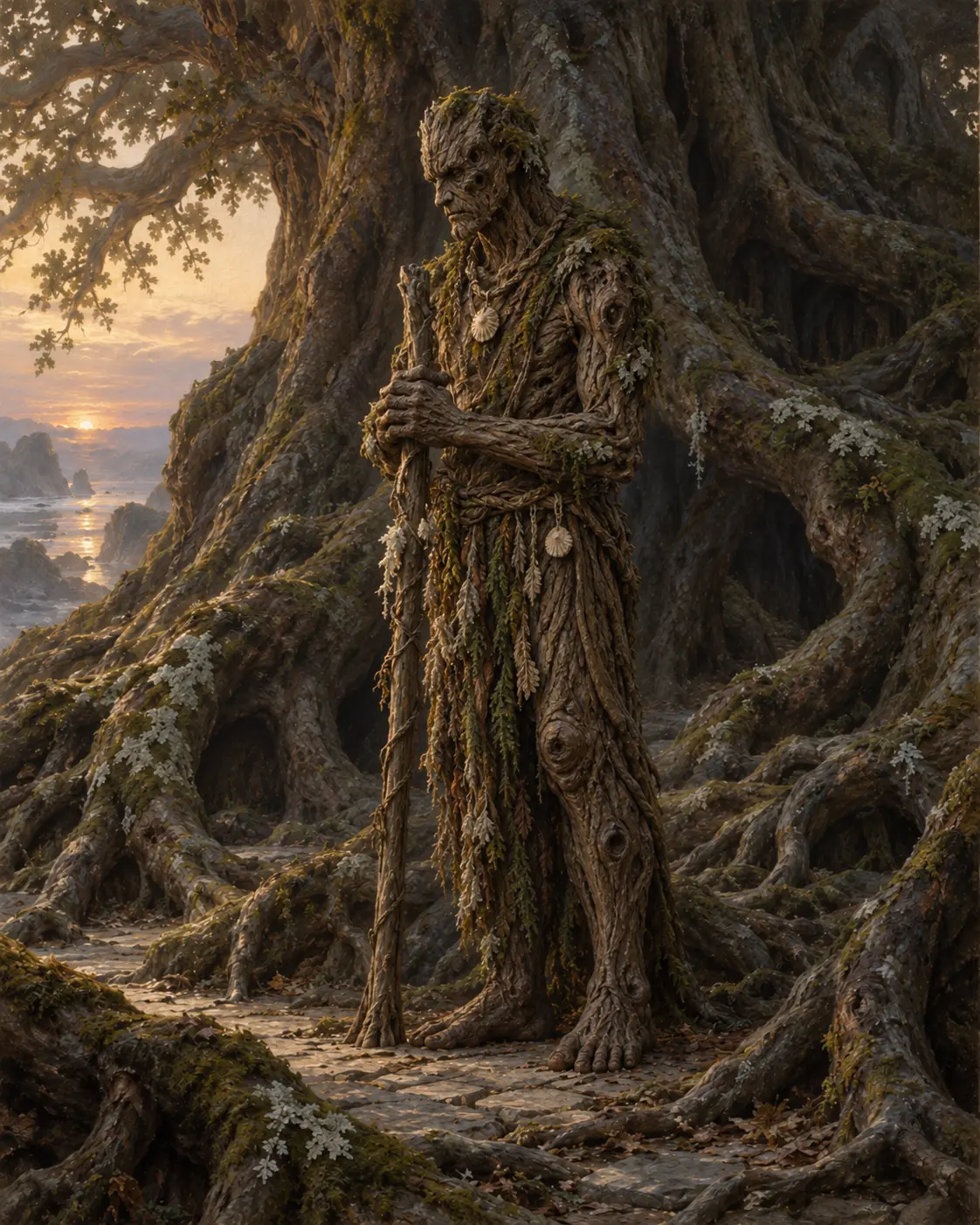
No Shira has tried it since. When one suspects another of reaching too far, the rebuke is three names and nothing more: Uthmir. Halun. Athelor. It is said like a prayer.
The Grove Worship
The second quarrel was over what the Mim are. About the middle of the age, in a time when the worker caste were ruling the Shira, a party of learned priests began to teach something new. The trees, they said, were not go-betweens for some higher order. They were gods in their own right, and should be worshipped directly. They called the teaching drai-ne-mir, the Grove Worship, and they believed they were correcting an ancient error.
The rest of the priesthood answered that the trees had never claimed to be gods. In the oldest stories the trees named themselves intermediaries and spoke of an order above them. The Grove Worshippers replied by doubting the oldest stories. Over some decades they stopped keeping certain rites. They drew their villages away from the rest of Shira life. In the end they raised defences around a handful of settlements deep in the forest.
The council of workers, pressed by the priests, called it a matter for correction. For the first time the warriors were sent out for something other than ceremony. The fighting lasted four months. Some three hundred died — a number no quarrel among the Shira has come near since. The survivors were taken back or sent into the far north of the forests, where a few of their descendants are still, now and then, said to live.
The priests’ answer stands to this day. The trees are intermediaries, not gods. What they point to is a mystery no fragment of Shira verse we have has named.
The Ebb
The third quarrel ran the other way. It took a century rather than four months, and no one died of it.
Late in the age, in a long run of peace and good harvests, a faction among the farmers argued that the priests had outlived their use. They had been needed in harder times, the argument went, but the Shira were grown now. The priests’ caste should be dissolved, its members dispersed and given other work among the orders. Their founding paper said that the priests have ebbed from necessity, and the Ebb was the name that stuck.
The Ebb gathered support for decades, and for nearly a hundred years the dispute ran cold. Step by step the farmers cut the priests down to a voice that could advise and no more, and shaped Shira life around the belief that the priests’ time was ending.
Then the mer came.
Out of the Deep
For most of that age the Shira had known the mer only as a rumour: an older people of the deep water, glimpsed now and then off the eastern coast, never coming ashore. Late in the age a delegation surfaced off that coast and asked to meet the leaders.
How they came ashore is a matter touched on elsewhere. The mer are a sea-people, but their later embassy to the realms of men showed that some travel on land in sealed tanks carried on mechanical legs. If Osric’s account is sound, the delegation to the Shira came by the same means. They were received with courtesy and some amazement.
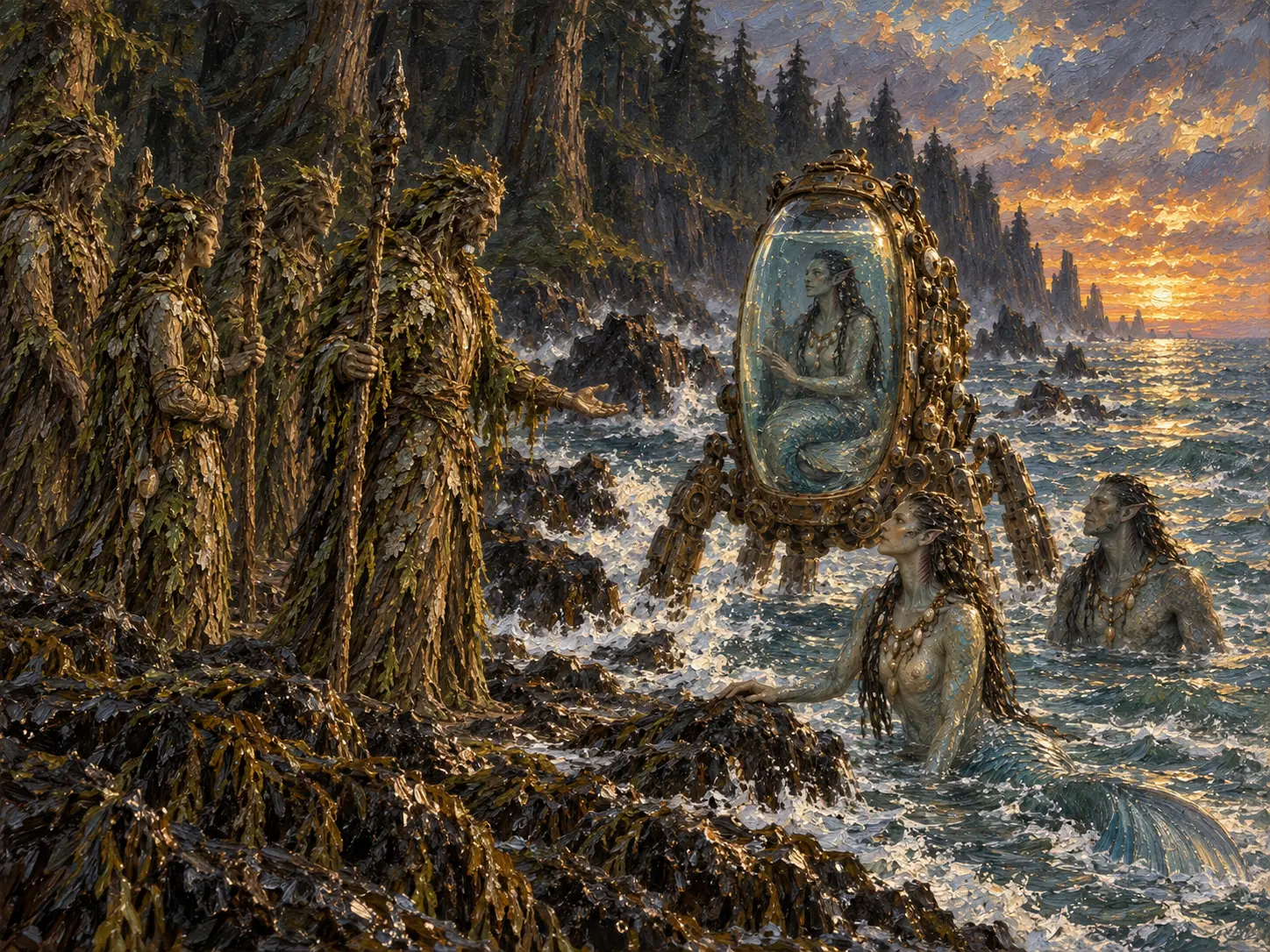
The mer were older than the Shira themselves. They could do things the Shira had not imagined could be done. And they came in peace. Within a year the Ebb was over. A great deal of business had arrived that only the priests knew how to conduct, and the farmers could not do it. The priests returned to full standing. No one was punished for the Ebb, and no one has raised it since.
What followed was a friendship, and it lasted centuries. The mer were curious about a people grown from trees. The Shira were impressed by what the mer could do, and willing to learn from it. Knowledge went both ways. The mer learned of the Mim and of Shira magic, and the Shira learned mer engineering, and the mer’s knowledge of living bodies. It is the only time, so far as I have found, that the Shira have kept company with another people as equals.
The Souring
It did not end well, and it ended in stages.
The first break came from the north. For centuries, it turned out, the mer had been mining the White Mountains in secret. The Shira counted that country neutral ground at best, and near enough to their own that anyone working there owed them a word first. No word had been given. A party of Shira priests, tracing strange disturbances in the north, stumbled on a mer camp. The tanks stood in the shallows and the digging was already well advanced. The report reached Althuz within weeks, and the elders were deeply offended.
The mer, confronted, were dismissive. The mountains were not the forest, they said. The Jade lay between. The digging was small. The friendship had always allowed for some unevenness. The Shira did not agree. The mining went on, on a smaller scale, for another century or so, and then stopped for reasons the mer never gave. The Shira did not forgive it. Dealings went on, but the warmth had gone out of them.
The second break came from the sea. The Turtle’s circuit carries it again and again along the Shira’s eastern shore, and its passing tore at that coast. It turned the tides. It harmed Mim that grew near the water. The Shira protested to the mer. The mer granted there was a difficulty and offered nothing to mend it.
The Shira held them responsible, and not without reason. It has long been supposed that the mer set the Turtle on its course. At the least, they may have possessed the knowledge and power to alter that course and chosen not to. The purpose most commonly given is that the Turtle’s orbit made open sea travel all but impossible, and so kept the mer’s own empire hidden beneath the waves. The sea had already been difficult, between the pull of the two moons and the currents they breed, but the Turtle’s endless circuit closed it. The mer drew back into the deep, as they do from time to time, and did not answer.
So the Shira set out to mend it themselves. Over several decades their mages grew a barrier in the shallows off the eastern coast, of shaped coral and root and stone — the largest work they had ever attempted. It was meant to turn the Turtle aside from the coast or, in the boldest version of the plan, to hold it fast. When the Turtle reached it, the creature quickened and broke it in a single passage. The Shira accounts agree on one thing above the rest: the Turtle seemed to know what the barrier was, and chose to break it.
The Shira went to the mer for an explanation. Still withdrawn, they gave none. The Shira counted the friendship over. When the mer surfaced again, centuries later, they were not received. They are said to have been refused ever since.
Three Pyramids
They answered the Turtle in stone instead. Osric’s pages lend weight to the common belief that the Shira learned the pyramid from the mer. During the years of friendship, the mer had told them of the great structures they had raised on the seabed.
About a century after the barrier fell, once the priests had finished the long study the work required, the Shira began the first pyramid at Althuz. It took some eighty years to raise. When it was finished and woken, the harm along the coast stopped. The tides settled. The damaged trees began to recover. The Turtle passes still, and the coast is quiet.
The quieter coast did not serve the Shira alone. Centuries later, settlers from Aur fleeing a lost war across the Wild Sea found the calmer waters passable enough to make land. They built the Chalk Towns in the White Mountains and raised Hursts on the forests’ southern edge. The very work the Shira had done to protect their shore opened it, in the end, to the neighbours they least wanted.
The second and third pyramids followed over the centuries after, each built to its own purpose. All three were complete some thirteen hundred years ago, and have stood working since. The gold is tallest. The red is narrower and more severe. The white is smallest and the most finely worked. They used only what could be taken without offending the land: shell, coral and deep-sea salt from the eastern shore, resins tended for centuries. Stones were found rather than quarried, and metals mined from the few places the priests permitted them to work.
What the second and third pyramids are for, no one outside the forest knows. The first is the only one whose work the world can see, and it sees it only as an absence — a coast strangely unbroken by the tumultuous currents that press against it. Althuz grew up around the three. Before them the Shira had moved their seat more than once. Within a century of the last pyramid’s completion the elders settled there, and they have sat there since.
That is the whole of what I have of the ages in which the Shira became themselves and then turned from the sea. For what happened behind the trees I have Osric and no one else, and I have found no second account to set against his.
But the turn from the sea was not the end of other peoples’ dealings with the Shira. Centuries later, a single traveller arrived on the eastern coast, received with a gravity the Shira had shown to no visitor before or since. That meeting, what was spoken there, and the prophecy already set down in Kalin’s hand belong to the entry that follows.