The Jade River runs through the middle of the continent of Tuith like a seam. It is broadest at the Deluge, a freshwater sea, its currents running against one another, its edges thinning into swamp, its whole breadth too wide for a crew of brave oarsmen to cross in a day. From that central body the river extends in several directions, thinning as each arm goes its own way toward desert, sea, or mountain cold. The Niru are everywhere it runs.
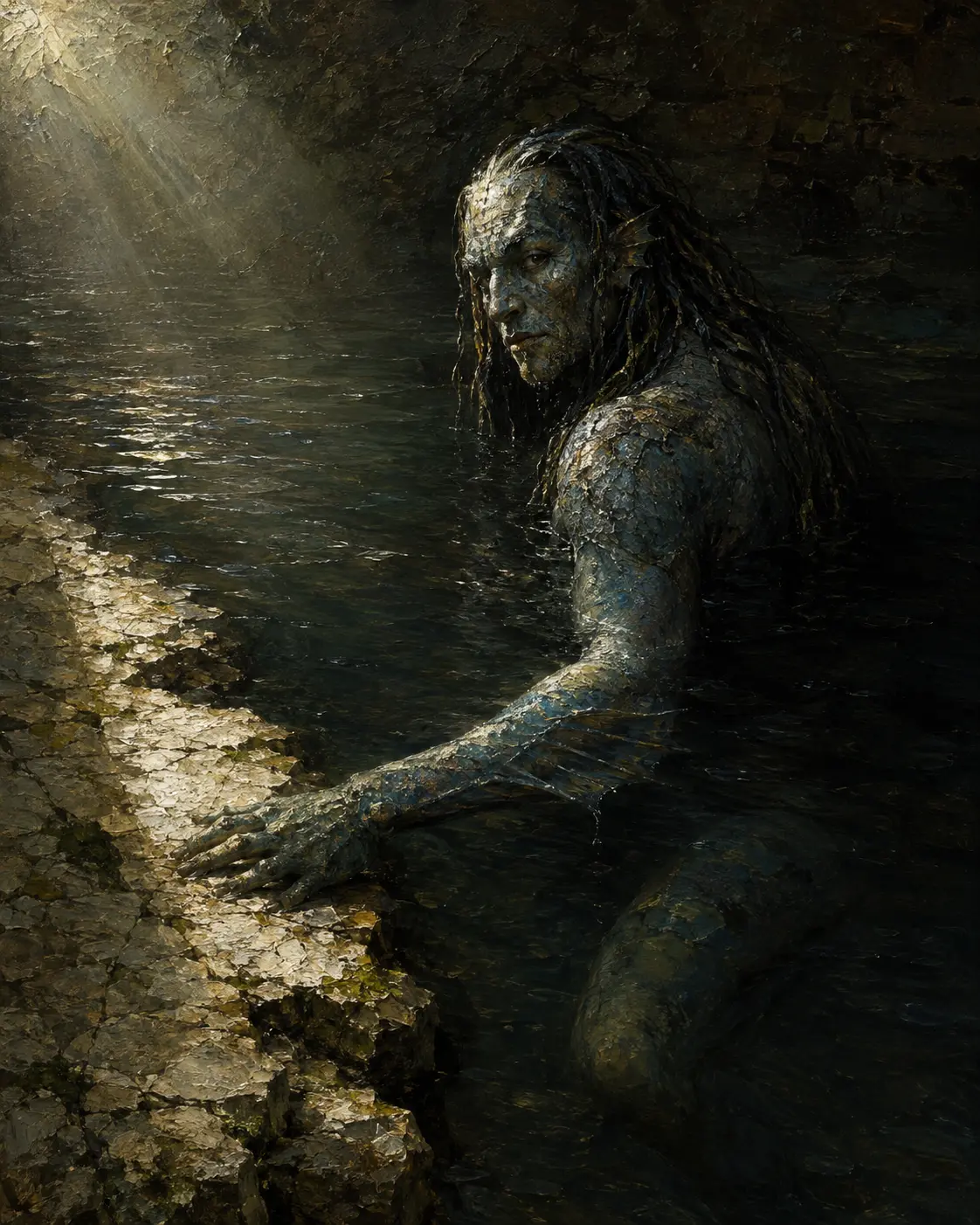
They breathe water. This is the first thing anyone reports of them, and it has not grown ordinary in many years of hearing it. The Jade fills their lungs as sustenance rather than drowning; they move through the current as men move through a crowded street. Down their legs and forearms run webbed fins. Their skin runs from deep indigo through aquamarine to bronze, greying toward stone with age, and the oldest among them are difficult to distinguish from the limestone they have lived in longest.
They have legs, and can walk on land, though the water is their home and they are seldom long from it. They live some two centuries — long, by the reckoning of men, if perhaps not by the reckoning of the other races of the world.
The Call and the Mother
“The Call” is the rough translation of the Niru’s oldest text, carved into the stone of the origin caves, read by touch, carried in the isan they sing. In it the Mother names them and tells them what they are for: the river’s own, born of her, charged above all else to guard the Jade and suffer no crossing. Every faction in Niru history has claimed the Call. The elders read it as a charge laid on themselves, the appointed few. The Children, a hundred generations later, read it as a charge laid on all.
The Mother is the name they give to their deity. Her presence is said to be felt by every Niru as an ambient pressure against the skin in the water — the saru, they call it: the sense that the river holds them.
The Niru believe that throughout the Jade, the Mother has set her “water-mirrors”, a sort of crystal worked into the stone of every reach. The material I cannot speak to directly. I have read descriptions of it as a deep violet, all but translucent in the dark of the limestone. I have also encountered, in certain records, the name aket attached to it — a substance whose very existence is not universally credited, and about which I have formed suspicions I will set out in their proper place.
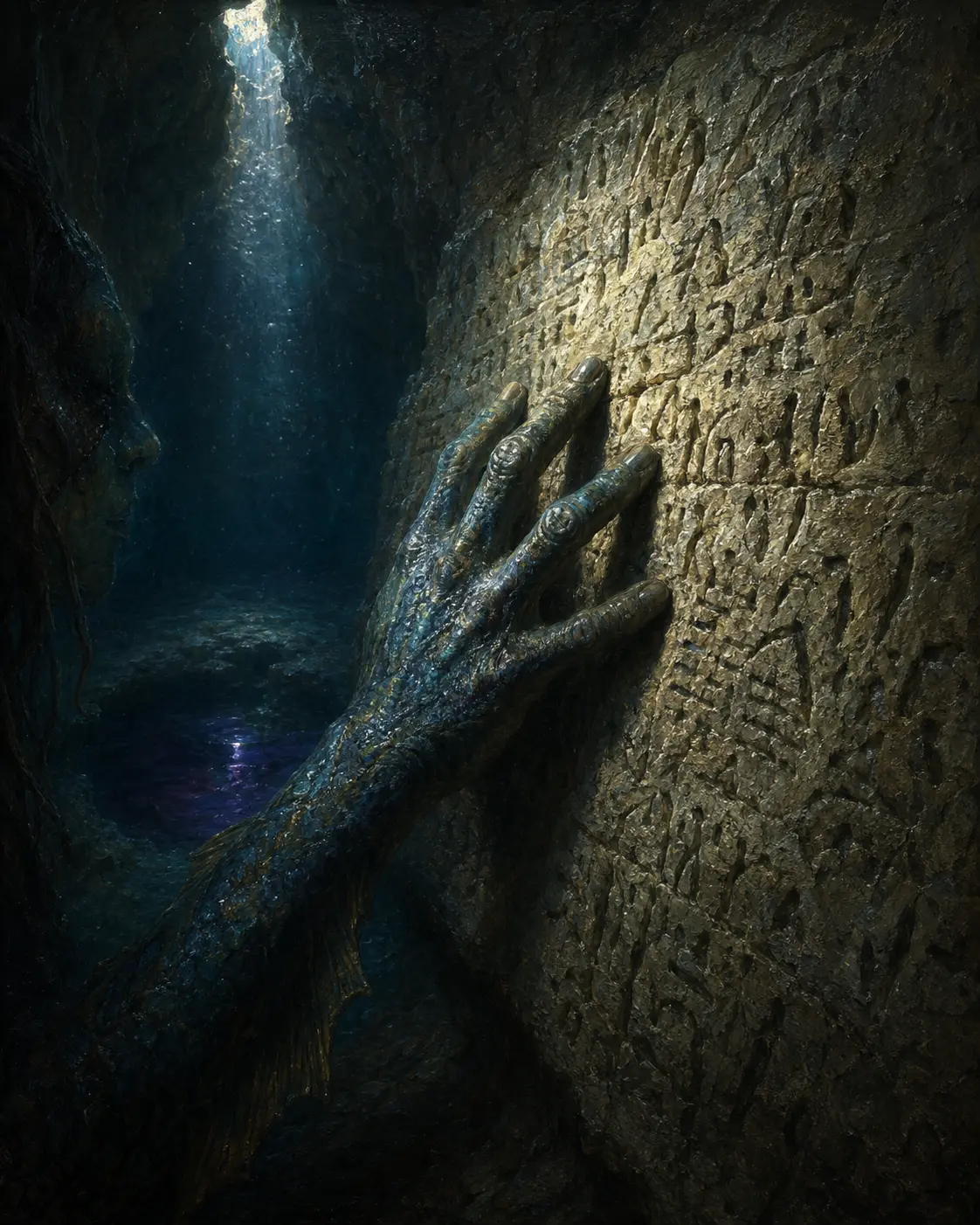
The Niru are said to believe that the Mother speaks to them through these water-mirrors — but only to very few in any generation. The right to declare her word became, in time, the possession of those few. From the gifted communers came the river-readers, and from the river-readers the N’rands — a Niru word that renders, roughly, as those who carry the word from one to another. From the N’rands came the Council of Elders, which has governed the Niru from Ta’chi in the south for many centuries. The Niru have no kings. They have a Council who hold the Mother’s word. The word is: hold the river.
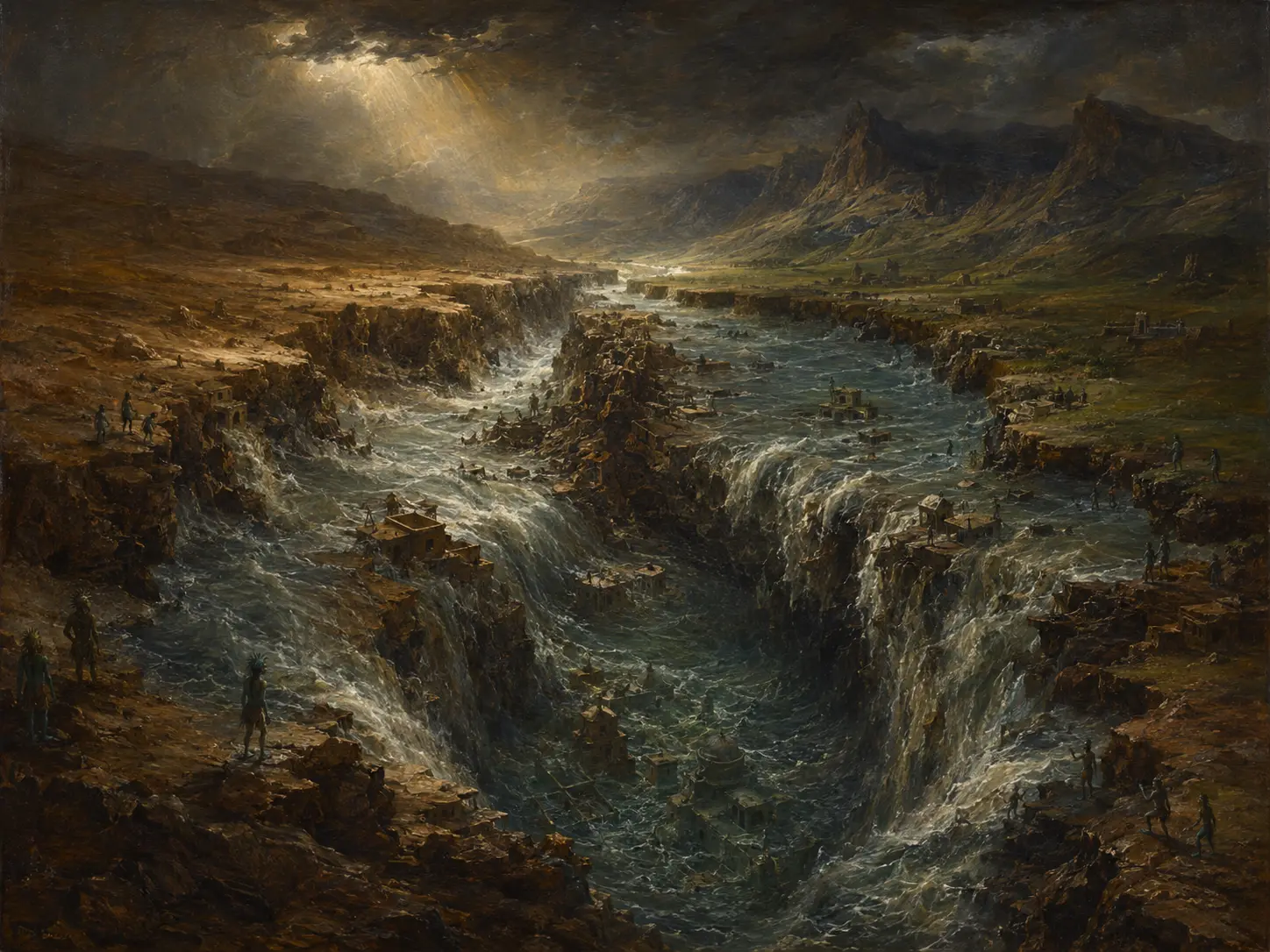
Early in their history, before any city or law, came the disaster the Niru call the Sundering. The northern channel split. Settlements that had stood for hundreds of years were lost in a night, and much of the young generation perished. The Niru read it in the only terms they had — the Mother’s wrath, or her warning. They moved further south after the disaster, and patrols of the river crossings grew as a result.
What came out of the grief was the isan: a music shaped from the pressure and pull of the water, made by the whole body and received on the skin and in the chest. The earliest were laments, the names of the drowned given to the current and carried into the dark of the caves. It was the first thing the Niru had made that served no function, guarded no crossing, held no line.
The Silencing
The challenge to the elders’ arrangement came early. A communer named Rhoswen, generations after the great southward migration, went alone to the origin caves in the north and stayed a season. She returned preaching what the Council could least afford: that the Mother was near to any Niru who sought her, that she had appointed no keeper of her word, and that the abandoned caves were the one place she could still be reached with no broker standing between.
The Council did not debate her. They closed the caves. They declared the north perilous — too dangerous since the great breaking of the channel — and forbade the pilgrimage on pain of exile. The prohibition is known among them as the Silencing, and it turned the Council’s authority from custom into law.
The elder who pressed the Silencing hardest was one Maddoc, a N’rand of the southern line whose word carried further than any of his generation. What became of Rhoswen their histories will not say plainly. She was cast out and forbidden to return. There are rumours she was killed at Maddoc’s word, and the death then covered over. Where she ended, no record I have seen will name.
Maddoc himself lived long, as the Niru do, and outlasted the woman he silenced by the better part of a century — long enough to set two factions of the southern river against one another in a quarrel the Niru still remember as the Red War, named for the colour of the river throughout its duration. Men learned much of what they know of the Niru during that period, from the bodies that washed up on the shores of Byercet. The argument Rhoswen carried was buried with her, and has since been dug up more than once.
For most of their history the Niru guarded their river and were left to it. What changed was the long war of men — a conflict this record has treated in its own entry — and within it, a king the Niru have not forgotten.
Llandāc Bekādith the Second, King of Byercet, in one of the bitterest stretches of the thousand-year war with Pax, resolved to turn the Niru and the Shira into weapons. Byercetian expeditions crossed the river and the forest’s edge over several years, carrying off Niru and Shira together to be bound and set to war for a kingdom not their own.
The Council counselled endurance: the sacred duty was to guard the crossings, not to make war beyond them. The Shira’s own Council, made up of the Farmers, whose turn it was at the time to rule, counselled the same, though they fortified their shoreline so the incursions became harder to achieve. The captives were neither ransomed nor avenged. It is the elders’ plainest failure, and the one the Niru have least forgiven.
The one who would not wait was not a Niru. He was a Shira holy man called Ovren, taken in the same slaving years and held among Niru captives, and it is the first strange fact of the order he founded that a Shira set them alight. He preached to both peoples at once. He taught that the Call’s charge had been laid on every Niru, not held in trust by elders who sat safe while their people were taken in chains; and that when a tyrant enslaves the innocent and the appointed powers will not move, it is just — it is holy — for the people themselves to take up arms.
He led the first combined action the two peoples ever mounted, a strike on a Byercetian slaving fleet at the southern narrows, where Niru and Shira mages broke it together and freed the captives of that season. Ovren fell in the fighting.
The movement he began survived him. The Niru who had followed him made of it an order, the Children of the River, and it has not dispersed, though the Council has put it down more than once and believed it finished. They keep their bases in the western channel, nestled between Byercet and Pax where few crossings have ever been patrolled. They carry Ovren’s teachings carved in stone, sung in the isan, read by touch in the dark, with no N’rand standing between the people and the words. Among the Niru, at the time of this writing, there is said to again be a gathering of the discontented around his oldest claim: that the Mother speaks to whom she will, and that the river belongs to every one of her children.
The crossing at the Deluge
Some fifty years ago, settlers came across the sea from Aur and built where no kingdom of men had stood before: on the south-eastern coast, hard against the forests, and high in the White Mountains to the north. For the first time in Niru memory men pressed on the river from both banks at once, and these newcomers had numbers, engines, and no habit of asking leave. When the Niru turned back their first parties, they forced the water, and blood ran on both banks in a scatter of skirmishes fought on the banks of the Deluge.
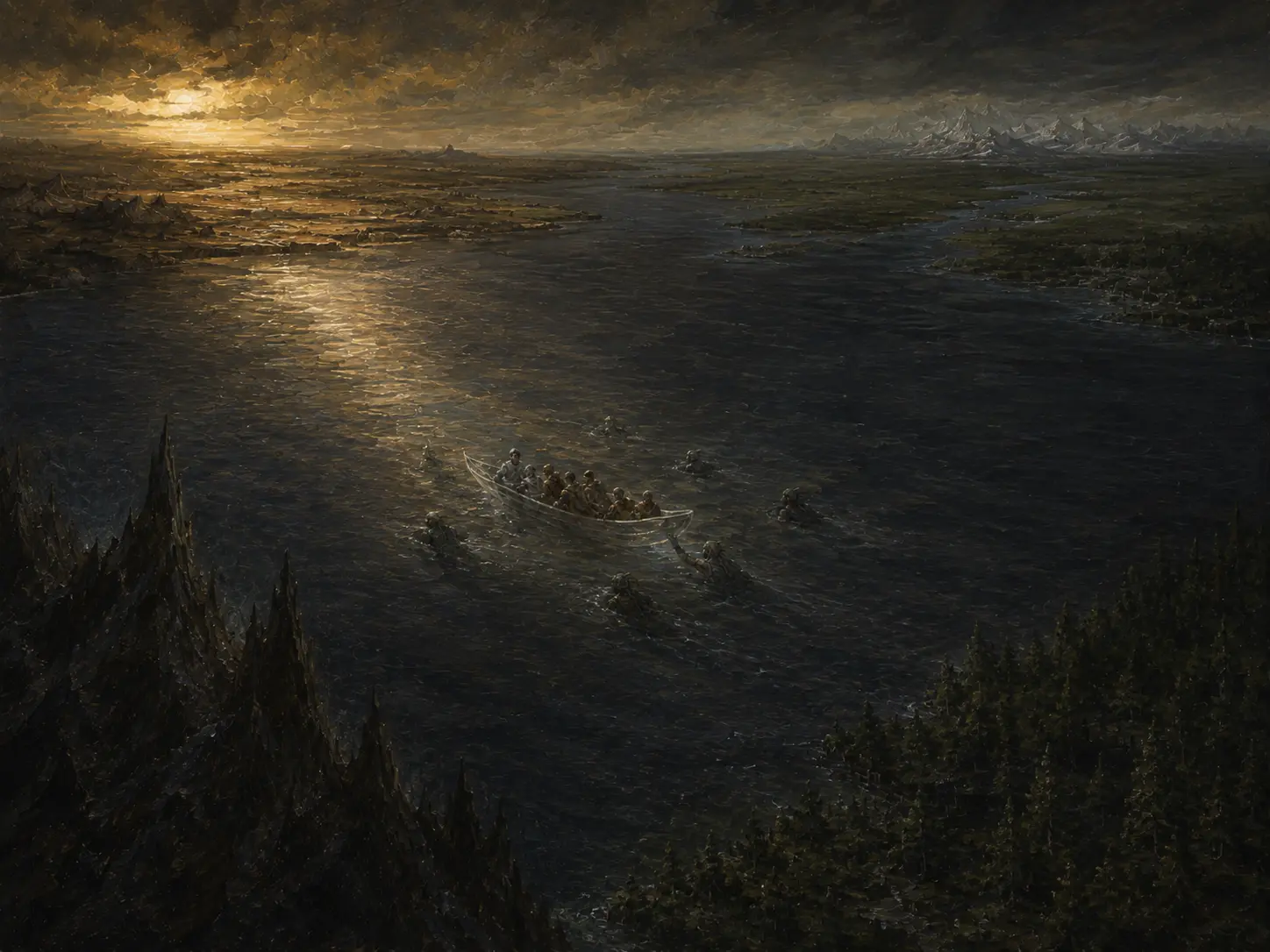
What ended the fighting was not a victory but a treaty. One crossing would be suffered, at the Deluge and nowhere else, worked under the Council’s own hand: the Niru to pilot the boats, elder-appointed soldiers to guard the passage, and men to cross the continent at that single watched point. The elders took it grudgingly and named it stewardship of the crossing rather than surrender of it. Many of their own people have not been so gentle with the word. The guardians of the Jade now ferry men across the very water they were made to close, and take a toll for it; and the Call, as I have read it, makes no provision for the exception.
The Shira, whose land the settlers had taken more openly than the river-folk’s — one of the new cities was raised on the forests’ own southern edge — made no protest that reached me. They are said instead to have written to the old kingdoms in the west, to Byercet and to Pax, seeking pledges of arms against further settlement, and to have had no answer. That they suffered the accord to stand while their forests were encroached upon is less strange than it first appears: a crossing at the Deluge keeps men to the north and moving, away from the western line of the forests, under watch the whole way. What the river-folk carry as a wound the forest-folk may count a wall. The Niru who look to their cousins for a sign have read the silence each in their own way.
One rumour I set down last, because it is old and because those it concerns will not touch it. It is said among merchants and travellers, and has been said long enough to wear the look of authority, that the Niru did not originate in the river at all — that they were sent, near the turn of the Third Age, by the mer.
This may cause less alarm among men than one might expect. We are not without our own version of the story. The Byercetian royal house names the sea as its origin and the hydra as its sigil, and the belief — long held, and carrying more weight than it perhaps should, given the mer’s elder and mysterious standing — that men were themselves descended from mer has never quite been put to rest.
So the matter rests, uneasily, at the time of this writing. Of the settlers — of Hursts on the forest’s edge, the Chalk Towns in the heart of the White Mountains, and what manner of place the newcomers have made of them — I mean to give a fuller account in other places of this volume. And of the Niru there is more to tell than a single record will hold: the discontented gather in the western channel around a claim older than the Council, and whether the Call bends under the weight of the crossing or holds is a question the Niru have not yet answered. To that I intend to return.