
On the Endurance of Pax
A thousand years ago, a general named Jasen Amitath led a column of refugees north out of Byercet and into the desert. They had begun as a guild movement—tradesmen and labourers, later mages—and had turned militant when the crown moved to suppress them. A prophet named Fyodor Ibakos walked with them, or ahead of them, depending on the source. The histories of Pax remember a vision. The histories of Byercet remember a failed revolt.
No feudal lord had backed them. No province had risen in their name. By the time Amitath turned north, the movement had stalled, and the desert may have been less a destination than a last resort—whether Ibakos was truly receiving visions or merely providing one.
They settled at the northernmost reach of Tuith, where the continent narrows to a shelf of rock above the sea. Cliffs fall away to the north and west. To the east, the Fury Desert extends into salt flats and heat shimmers where no army could sustain a march. Only one approach remains: south, through the grasslands the Paxic would come to call the Savannahs.
It was, by any honest accounting, a terrible place to build a kingdom. It was an exceptional place to defend one.
Over the centuries that followed, the southern grasslands filled with fortified towns. Each sat at a natural chokepoint—a river crossing, a ridge, a pass between hills—and each forced any invading army to narrow its column, to shed its advantages of size, to bleed for ground that the defenders knew like their own hands. Byercet’s forces outnumbered Pax many times over. It made no difference. Geography compressed the war into a corridor, and in corridors, numbers count for less than walls.
Pax did not merely survive in the desert. The desert was the strategy.
The stone from the Orclands grew also. That is the plainest way to state it. It expanded, calcified, took the shape of a seat. The Paxic built their throne room around it. Their Revelators declared it divine providence—proof that the God had chosen their kingdom. Byercet’s priests of the Evening Star called it heresy given form.
What can be confirmed is that the throne endured, and that Pax endured with it. Whether the connection is causal or coincidental is a question I leave to theologians and mages.
Between Pax and Byercet lay the Orclands.
For a thousand years, they became the ground on which both kingdoms bled. The orcs themselves—a people older than either kingdom, occupying lands neither had any original claim to—were caught between two holy wars and destroyed by both. Their civilisation is gone. Their lands are now called the Wastelands, which is both accurate and convenient.
Pax and Byercet each claim righteousness in their long war—liberation against tyranny, the light of the true God against a rival darkness, depending on which chronicler one trusts. Neither speaks readily of the people whose country they turned to ash in the pursuit of those claims. The stone that became Pax’s throne was taken from the orcs. It may have saved the rebel kingdom. It saved nothing else.
They moved east, into the borderlands between the two kingdoms, and founded a settlement they named Dondotha—a Paxic rendering of the Byercetian dondetha, meaning “sanctuary”. That the founders chose a Byercetian word, however clumsily adapted, tells you something about their intentions.
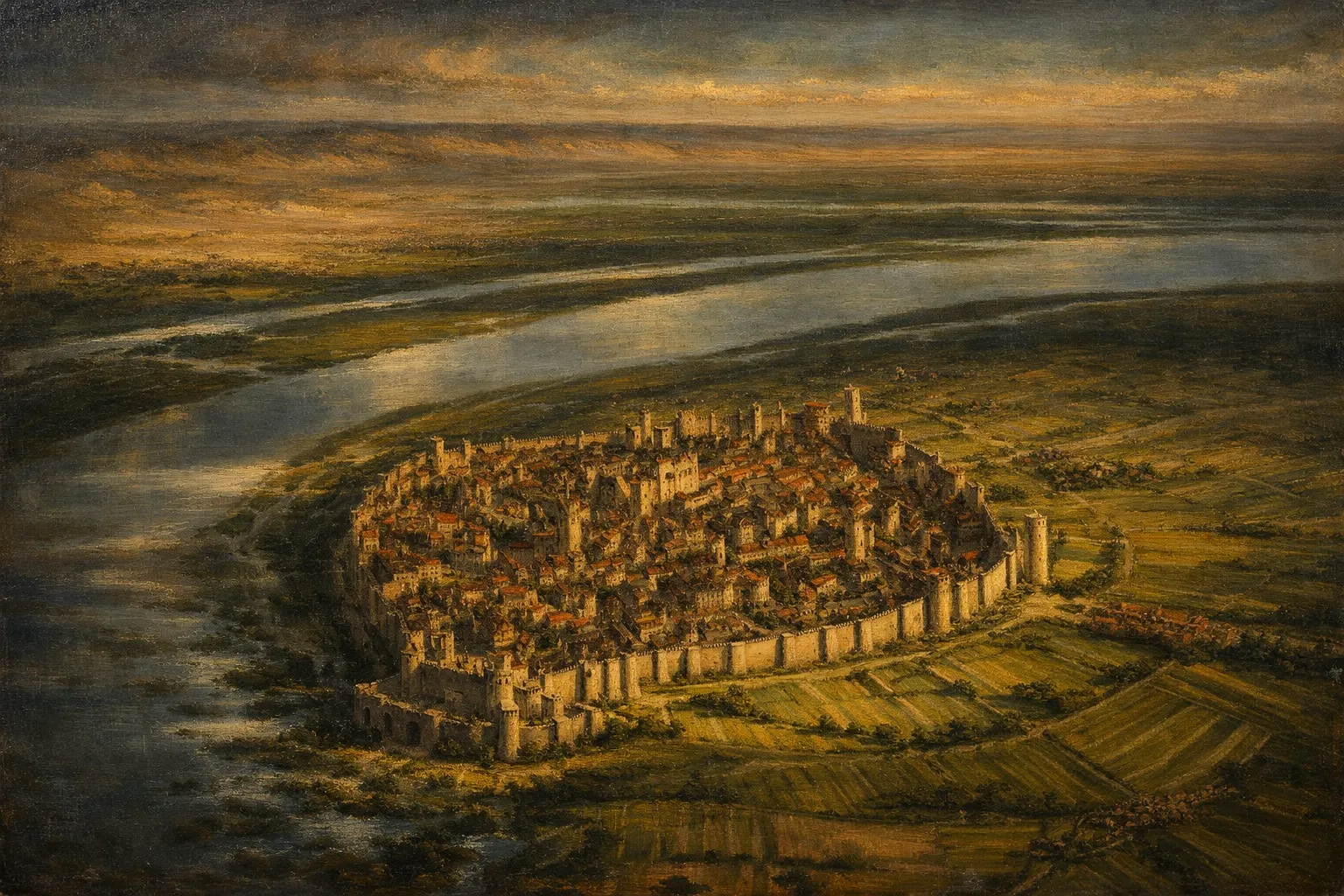
Dondotha declared absolute neutrality. It raised no army beyond what its borders required. It accepted refugees from both sides—Byercetian soldiers who had broken, Paxic farmers whose fields had burned beyond repair, merchants who wanted trade routes that did not double as front lines. Revelators and devotees of the Evening Star learned to live as neighbours within its walls, which may be Dondotha’s most remarkable achievement.
In Ma’ak, where I was trained, we were taught that Dondotha was an irrelevance—a gesture, not a power. This may not have been entirely wrong, once. But gestures accumulate. Slowly, agonisingly, the fact of Dondotha hollowed out the war from within. Not by force, but by example. A kingdom built on the premise that the war was a choice, not an inevitability.
Dreams do not end wars. But they do erode the certainty that they must continue.
What ended the war—officially—was fear.
Fifty years ago, Aurian settlers crossed the Wild Sea from Greater Aur, fleeing revolutions that had destabilised their own continent. They established settlements along Tuith’s eastern coast, bringing technologies and trade networks neither Pax nor Byercet had encountered. The war between the two kingdoms had been grinding for so long it had become almost ritualistic—familiar in its rhythms, predictable in its costs. The Aurian presence shattered that familiarity. Suddenly both kingdoms faced the prospect of irrelevance: keep fighting, and watch new powers reshape the continent while the old ones bled.
A peace was brokered. It took seventeen years to finalise. There were rebellions in both kingdoms—in Byercet, the treaty nearly ended the royal dynasty. But exhaustion won. Both sides signed.
By the war’s end, Byercet was fracturing. Independence movements had taken root in its southern provinces. Pax was fortified but hollowed out, its people ground down by generations of conflict. The Orclands were silent. And Dondotha stood, smaller than either kingdom, richer in moral authority than both—though moral authority, in my experience, purchases very little.
The treaty holds, at the time of this writing. Whether it will hold for the generation that inherits it is a question I cannot answer.