
There is a creature in the waters around Tuith, vast enough to carry a city on its back, that has swum the same circular path around the continent for as long as men have recorded such things.
No account survives of its arrival. No tradition tries to explain its origins. It swims. It has always swum.
Its orbit generates currents strong enough to make open-ocean crossing lethal, and its passage past any coastline is as predictable as the seasons, though far less understood.
The creature is alive. It breathes. Its shell is warm. The city on its back — Turtle City, as the mainland calls it — is not built on the shell so much as grown into it, foundations set into the living surface across centuries. Districts spread across the shell like quarters of any city, save that the ground pulses, and the lowest streets flood when the creature dives.
The people who live there call themselves the Free Men of Kedûr.
The Founding
In the mythology of Byercet, the first men were said to have climbed from the sea. There were twelve brothers. Āthrem Bekādith, the eldest, claimed kingship. He distributed lordships among the others as gifts — reminders of their subordination. Ten accepted. One did not. Kedûr, second-born, younger than the king by ten months, refused his portion and asked why they could not all be kings.
He sought allies. He didn’t find enough. Āthrem Bekādith defeated his brother and cast him back into the sea. Kedûr was meant to drown. He found the Turtle instead.
Whether Kedûr Bekādith was a single man or a name given after the fact to an entire tribe that broke from the first settlements is a question I have not seen addressed in the island’s own histories. I suspect the latter. It would explain much about the centuries that followed.
On the Turtle’s back, Kedûr Bekādith declared what the island still holds as its founding principle: that every soul is sovereign over their own person. No man could rule another. No lordship would be given, because none was anyone’s to give.
This is the vision that has shaped Turtle City’s two thousand years. It has done so the way fire shapes a forest — by burning through everything that cannot survive it.
But Kedûr carried something else from the shore.
As the stories go, before the brothers climbed from the sea, the Hooded Drogynor was already standing there. Every version of the myth attests to this. He was not a brother. He was not born from the water as men were said to be. He was there first — the figure who reached down and pulled the first man up, who placed the crown on Āthrem Bekādith’s head. In the religion of the Evening Star, the Drogynor is the Lord’s appointed hand in the mortal world. Divinely sanctioned. Above challenge.
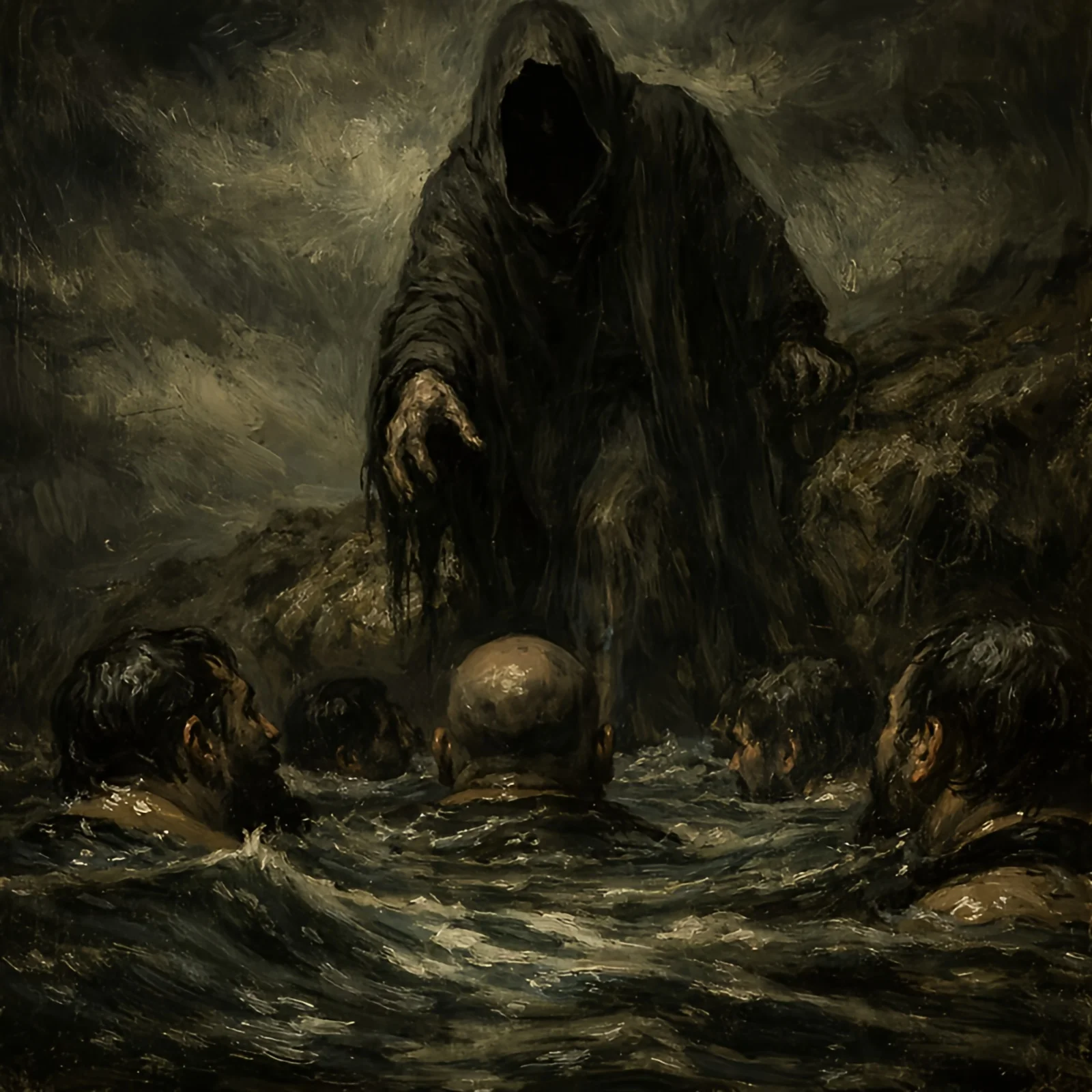
Kedûr rejected kingship. He did not reject the Drogynor. His telling differed — in the island version, no crown is placed on Āthrem’s head, because there is no crown — but the figure on the shore remained.
Kedûr feared him, and this fear took root alongside the principle of Free Men, tangled together at the base. With the Evening Star came the Byercetian prohibition on magic. On the mainland, magic outside the Drogynor’s authority is outlawed. On the Turtle, where no apparatus existed to outlaw anything, the prohibition became a taboo — deeper than law because it needed no enforcement.
The Quiet One
It is in the late Struggling Years — after centuries of failed attempts at some form of governance and factional violence — that the stories of the girl Mūtha appear.
Her name is Old Byercetian. It means little mouth or the quiet one, depending on dialect. An orphan who lived in the lowest reaches of the shell, near the waterline, where the tide pools fill and empty with the creature’s breathing.
No one remarkable, yet she understood the Turtle.
Not through speech or any teachable art, but through proximity — years against its shell, swimming alongside its flippers, pressing her ear to the surface of its skin.
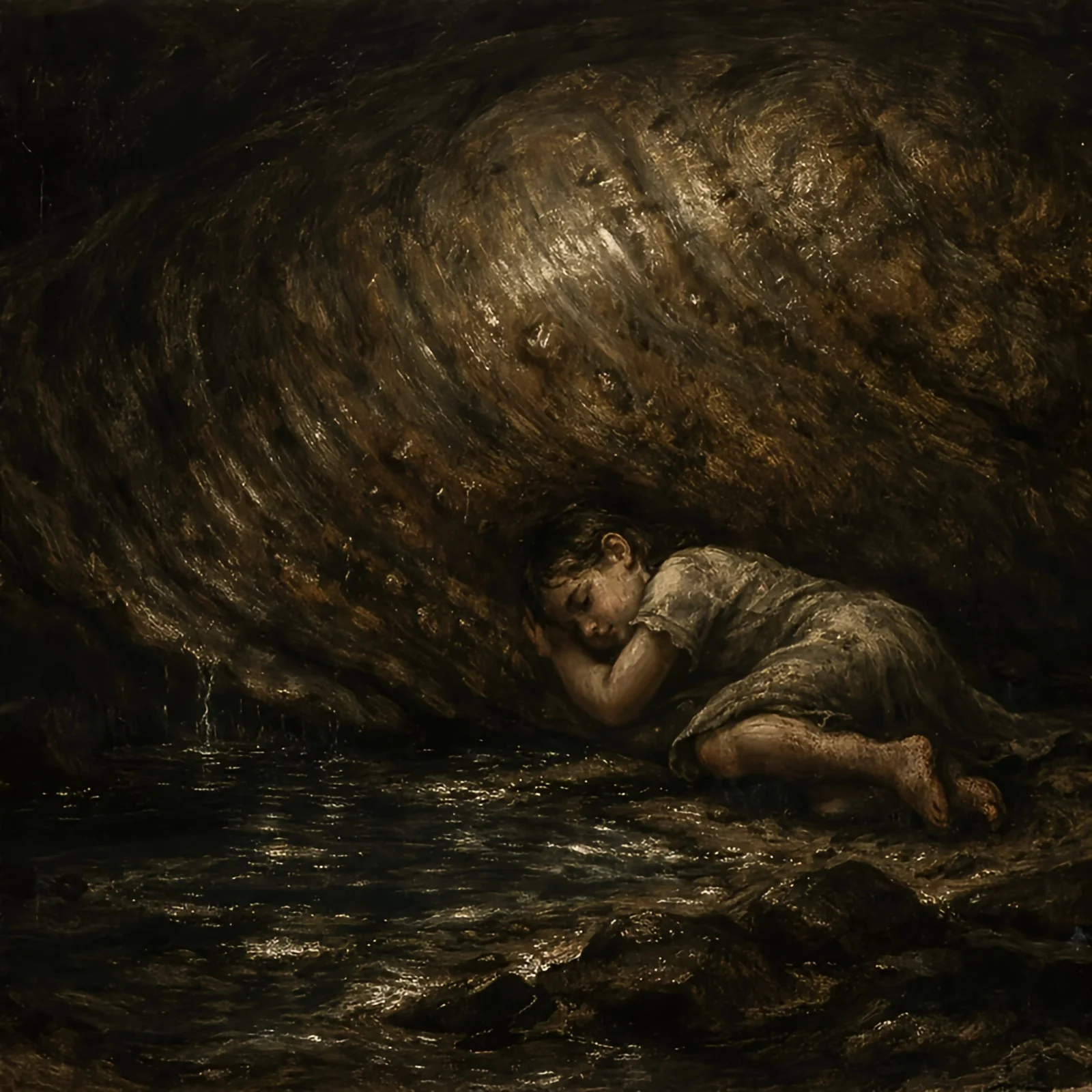
She was said to read the creature the way a rider reads a horse. When it shifted course, she had already braced. When it was agitated, she knew before the tremors reached the upper districts.
Some accounts claim she could sing to it and the creature would respond — turning, slowing, diving to wash a district clean. The pragmatists say she understood currents and dressed her knowledge in ritual. The islanders say something simpler. That she was the Turtle’s only friend in two thousand years of carrying strangers on its back.
The oldest versions of her story contain something the later ones omit.
They say the Turtle was in pain.
Not from carrying a city. A creature imprisoned in a path it could not leave, circling the same continent without end, for reasons it could not communicate and perhaps did not understand. Mūtha, lying in the waterline dark, is said to have felt it — a vibration beneath sound, rising through the shell. The old tellings call it grief.
The orbit was not migration. It was torment.
The pirate poet Hessad, writing three centuries later in his epic Tu’tata N’gylen — Eye of the Eagle — described the Turtle as a slave dragging its chains around the walls of its prison, and the chain is the sea, and the prison is the world.
The image has persisted ever since. It reframes the founding: the man who fled imprisonment on the mainland built his freedom on the back of something that was not free at all.
The Storm
A cyclone struck the island — one of the great storms from beyond the continent’s edge. The city was being torn apart. Mūtha went down to the waterline alone. She did not come back.
Within the hour the storm broke. The Turtle dove deep enough to flood every district to the waist, then surfaced miles away in calm water, as though it had swum beneath the worst of it.
Whether the girl guided it or drowned trying has been argued for centuries.
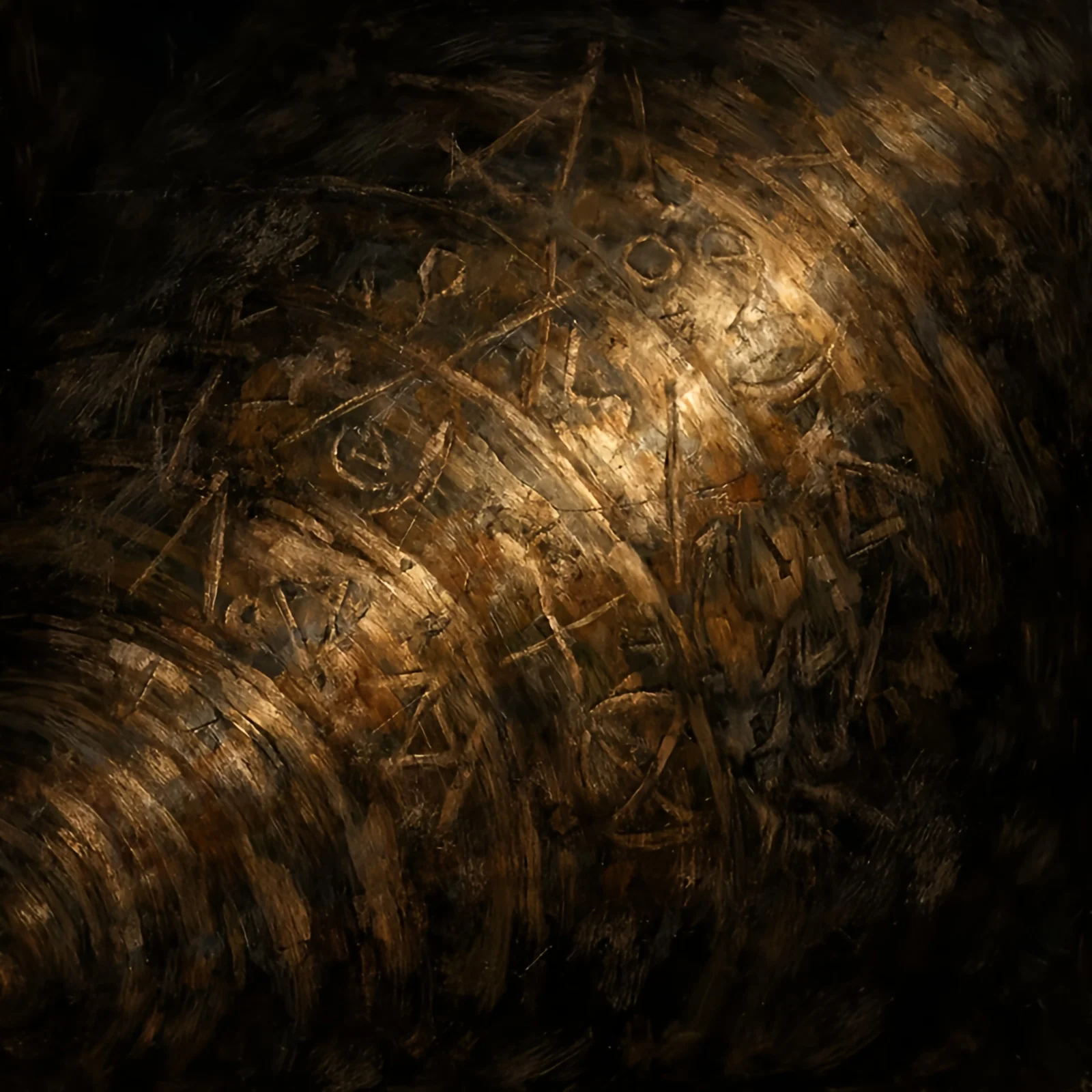
She did not remain a folk hero. Mūtha became something closer to a goddess — the island’s only native one. There are no temples dedicated to her. No priests serve her. No scripture proclaims her. But sailors touch the shell before departing and say her name. Children are told she watches from the waterline. Oaths are sworn on her memory. Her name is carved into the oldest stone on the island, and new carvings appear constantly — doorframes, hearths, the hulls of ships.
The Prophecy
Every prophet the island has produced has delivered the same message: the Turtle will one day die. The city on its back will be destroyed. And from the destruction, something new will be born — though no two have agreed on what.
Some spoke of a new island rising from the Turtle’s bones. Others of the people scattered across the world, carrying Kedûr’s vision into lands it had never reached. The most recent — an elderly Aurian woman who lived at the waterline for a decade before dying in her sleep — said only this:
The shell will crack and the sea will remember.
No one knows what it means. Everyone on the island knows the words, though.
There is a strand in the prophetic tradition that reads the Turtle’s death not as a catastrophe but as mercy. The orbit will break because the creature will finally be allowed to stop. In this reading, the island’s fatalism is not only we will lose everything but something stranger: the thing that carries us has suffered longer than we have known it existed, and one day its suffering will end, and ours will end with it.
The pirates of Turtle City do not build for permanence. They do not invest in legacy. They live with an intensity the settled kingdoms find unsettling — reckless, generous, brutal, and alive in a way the mainland is not.
The shell will crack and the sea will remember.
I have heard the words in the marketplaces at Dondotha, spoken by men who had never set foot on the Turtle. They are spreading. What that portends, at this late hour, I cannot say.
— The Chronicler