The smell of woodsmoke woke him.
He lay on his mat and watched the light move on the wall — a pale bar across the clay, sharp-edged, climbing slow. Past sunrise. Not long past. His mother’s voice somewhere outside, low, talking to someone, the words lost to the heat-thick walls. Goats further off. The dry scrape of a broom across stone.
He had been dreaming of the spring again.
Already fading — the way dreams always did — leaving only the after-feeling. Cool weight against his chest. Something almost-spoken, almost-heard. He lay still and tried to hold it. It went anyway.
Gone.
He pushed back the door-skin and stepped out. The flat of his fingers touched the lintel stone as he passed through the threshold. A habit so old he no longer caught himself doing it.
The heat met him, the way it always did. The air at ground level was already thick with it, the kind that came up out of the earth before the sun had finished arriving — a heaviness he could feel on his arms, across the backs of his hands. He stood a moment on the step and breathed it in. Dry. Mineral. Underneath it, faintly, the sweet-rot of goat dung baking in the yard.
The village lay scattered across the shallow rise — thirty huts of clay and bone ringed by a low thorn fence the goats kept knocking down. Past the fence the scrub gave out fast. The desert started where the green ended, pale and broken and going on for ever.
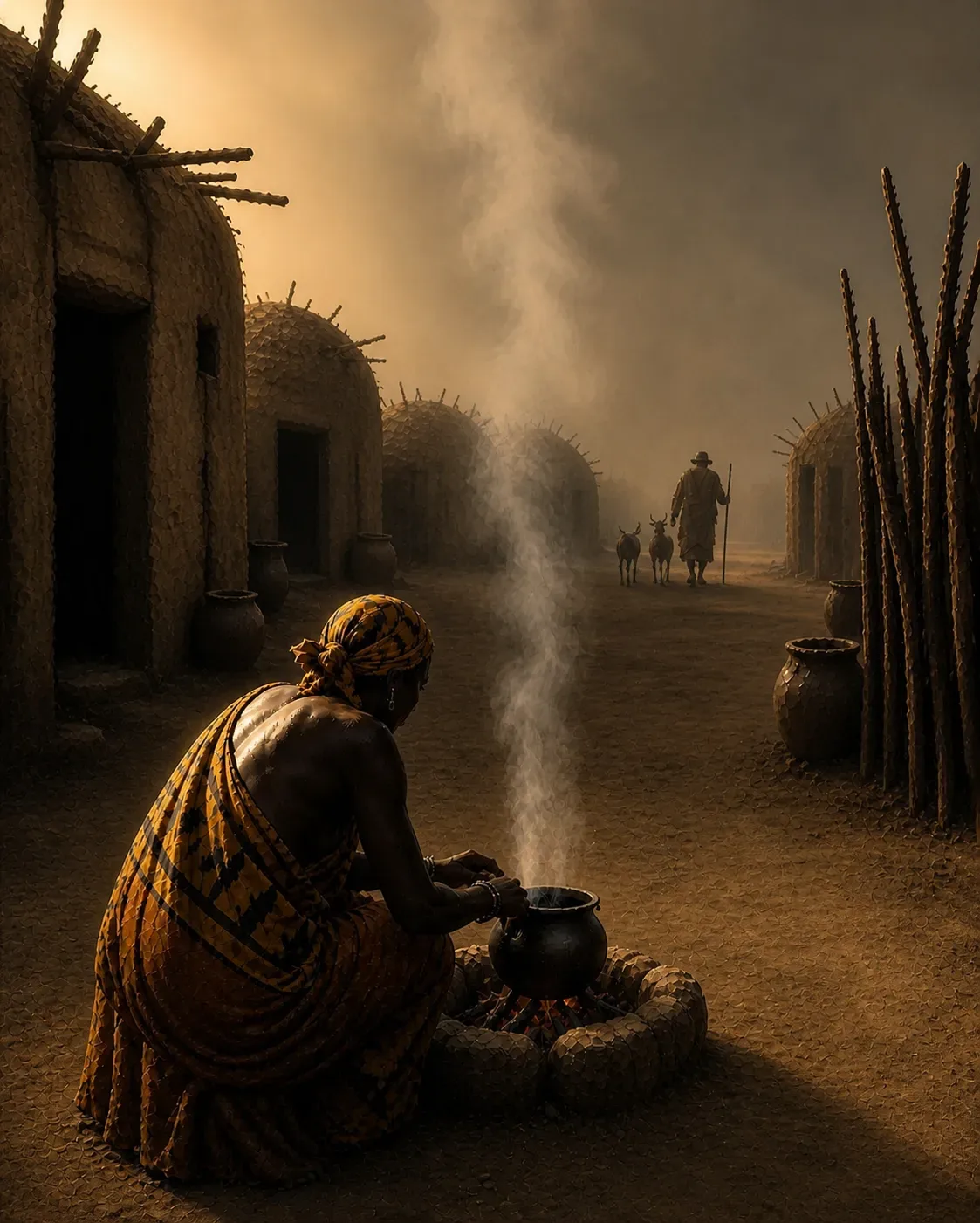
His mother was crouched at the cookstone, working a thin paste of millet and goat’s milk into the iron pan. Fragrant smoke curled around her. She wore the patterned wrap she had dyed herself last summer — yellow and rust, faded now at the shoulders where the sun had got at it.
She didn’t look up.
‘Half the morning gone.’
‘I dreamt.’
She paused over the pan. Her free hand went to her chest — caught it there, let it fall.
‘Sit. Eat.’
She handed him a flatbread folded around the paste. She had salted it. He could taste it on his back teeth — the particular salt they kept in the clay pot by the cookstone, coarse and grey. Hot, dense, the millet gritty between his teeth. He ate standing, watching the village come awake. Old Bekhal driving his goats between the huts, cursing them in the low flat voice he used for goats and children alike. Two women at the well — the taller one wearing a wrap of the deep blue the dye-women made from the stones above the river-bed, three days east. She was laughing at something. The laugh carried.
The rope-maker sat in the open beside his hut with a coil of pale fibre across his knees, working it without looking, his fingers reading the twist. He raised his chin when he saw Demessie watching. Demessie raised his back.
His father was crossing the yard with the herd-boys behind him, the long crook over one shoulder, moving at the pace he always moved — unhurried, like the morning had agreed to wait for him. He caught Demessie’s eye across the yard. Lifted his chin.
‘Back before midday,’ he said.
‘Mama already told me.’
His father smiled. It was a small smile, the kind that didn’t need teeth. He turned and went, and the herd-boys went after him in a ragged line, the smallest one half-running to keep up.
From the next hut over, a baby crying — Asteri’s brother, born in the spring, the cry thin and tired the way babies got in the heat. Asteri’s mother appeared in the doorway with the child against her shoulder. The cry stopped. She stood a moment and did not see him.
Smoke from a dozen morning fires drifted up into the still air. Above the smoke the sky was already white.
He ate quickly. His mother watched him from the cookstone.
‘Where are you going?’
‘The spring.’
She glanced past him — a reflex he’d stopped noticing years ago. No one within earshot.
‘Be back before midday.’
He nodded.
She held his eyes. Then she turned back to the pan and scraped the last of the paste onto a clay dish.
‘Sandals on. The rocks are hot already.’
‘I know, Mama.’
‘Demessie.’
He stopped.
She was looking up at him, the wooden spoon still in her hand. Smoke from the cookstone lifted between them and for a moment her face went indistinct behind it.
‘Be careful.’
‘I will.’
She drew breath. Held it. Let it out.
She turned back to the fire.
He went in for his sandals. When he came out the morning had moved another hand higher. He left through the south end of the village — past Tarêsh crouched by his father’s house, knees to his chin, throwing the same flat stone he’d been throwing at nothing for as long as Demessie had known him. He didn’t look up. He rarely looked up at anyone. The stone, the throw, the dust — the only constant thing about him.
Old Ïmhal on the low bench someone had built for him after his leg, the wooden stick across his knees. Talking to himself, or to the stick — Demessie had never been sure which.
Beyond the last hut the road thinned to a track. The track thinned to nothing.
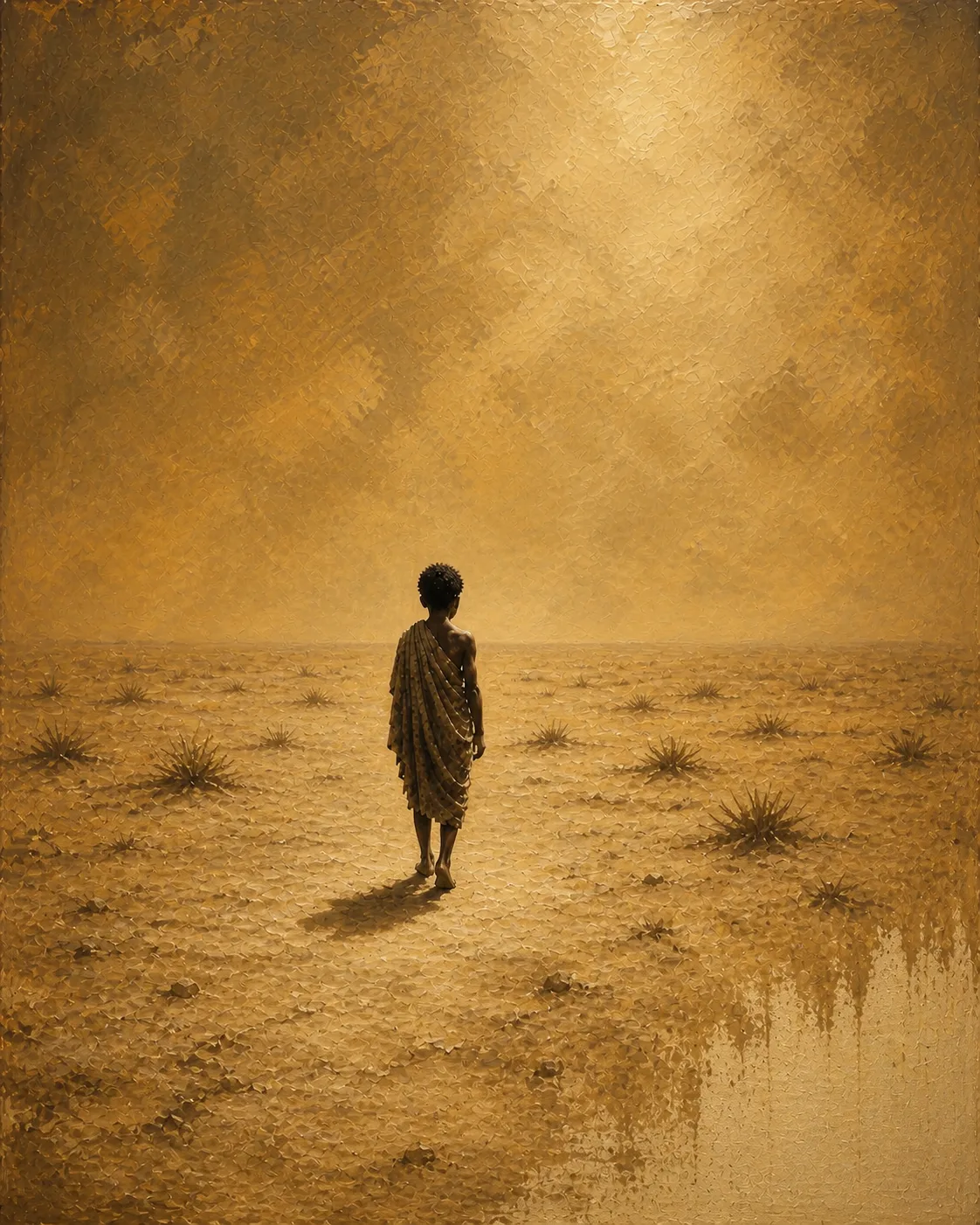
The desert opened in front of him.
He went easy. He’d done this walk so many times the ground knew him — bare rock and scrub, the long shadows of the standing stones still holding their morning cool. His feet found the path that wasn’t a path, only a faint pressing-down where the same small feet had gone a hundred times. He knew where the stones turned under his sandals if he stepped wrong. Knew the crack where a snake had once watched him and not moved, and he had not moved either, and after a long time the snake had gone back inside and he had walked on. He still slowed when he passed it.
It might still be there.
The voice of the spring was already in him.
A pull. Low, continuous, below hearing. It had been there since he’d cleared the village. The way north was there, or thirst. An awareness of water moving through stone somewhere ahead of him, patient, very old. It tugged at the same place in his belly it had tugged when he was six and first followed it out here alone.
He hadn’t told anyone. Not then. Not since.
That first time — everyone gone to a wedding two valleys west, his mother letting him stay because he’d complained of his stomach. Six years old, sitting in the dust by the well with no one watching, and the voice had come up out of the ground beneath the water and he had stood up and walked. Hadn’t stopped until he’d found the fold of rock. His mother had been waiting at the south end of the village when he came back with the sun going down. She hadn’t asked where he’d been. She had looked at him for a long time, washed his feet, and put him to bed.
He thought of his father — the long crook over his shoulder, the small smile. Out past the scrub now with the herd-boys.
Far off, a kite turned in the white sky on motionless wings.
The fold of rock came up by degrees — the kind of place the desert kept hidden by being ordinary from every angle. Two long shoulders of stone leaning into each other above a narrow gap, and the gap going further back than appeared at first glance.
He slipped through.
Inside the fold the heat dropped. Not by much. Enough. The light went green where it touched the scrub at the basin’s edge — a thin tough growth, leaves like little dark coins, the only green for half a day’s walk. And the water.
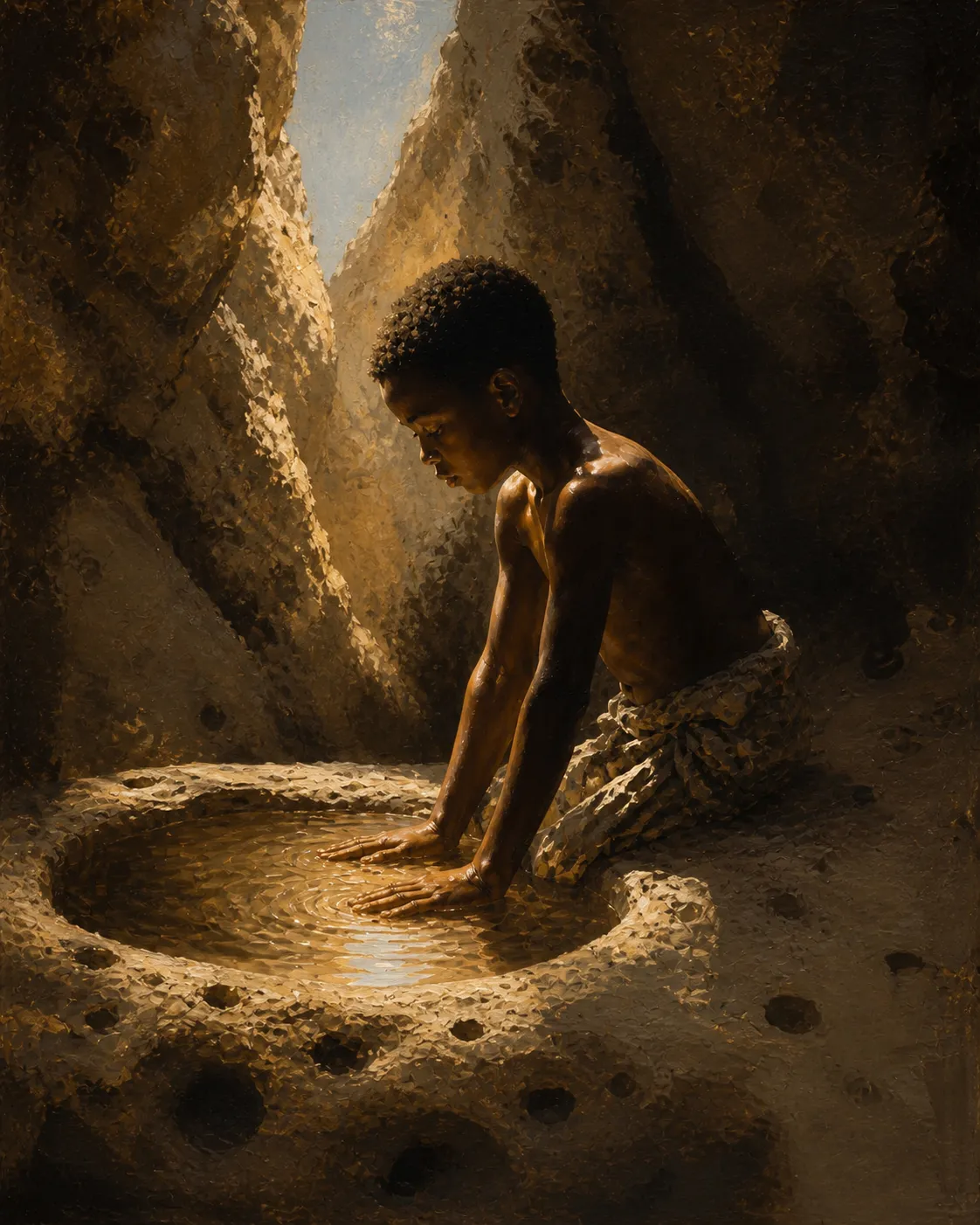
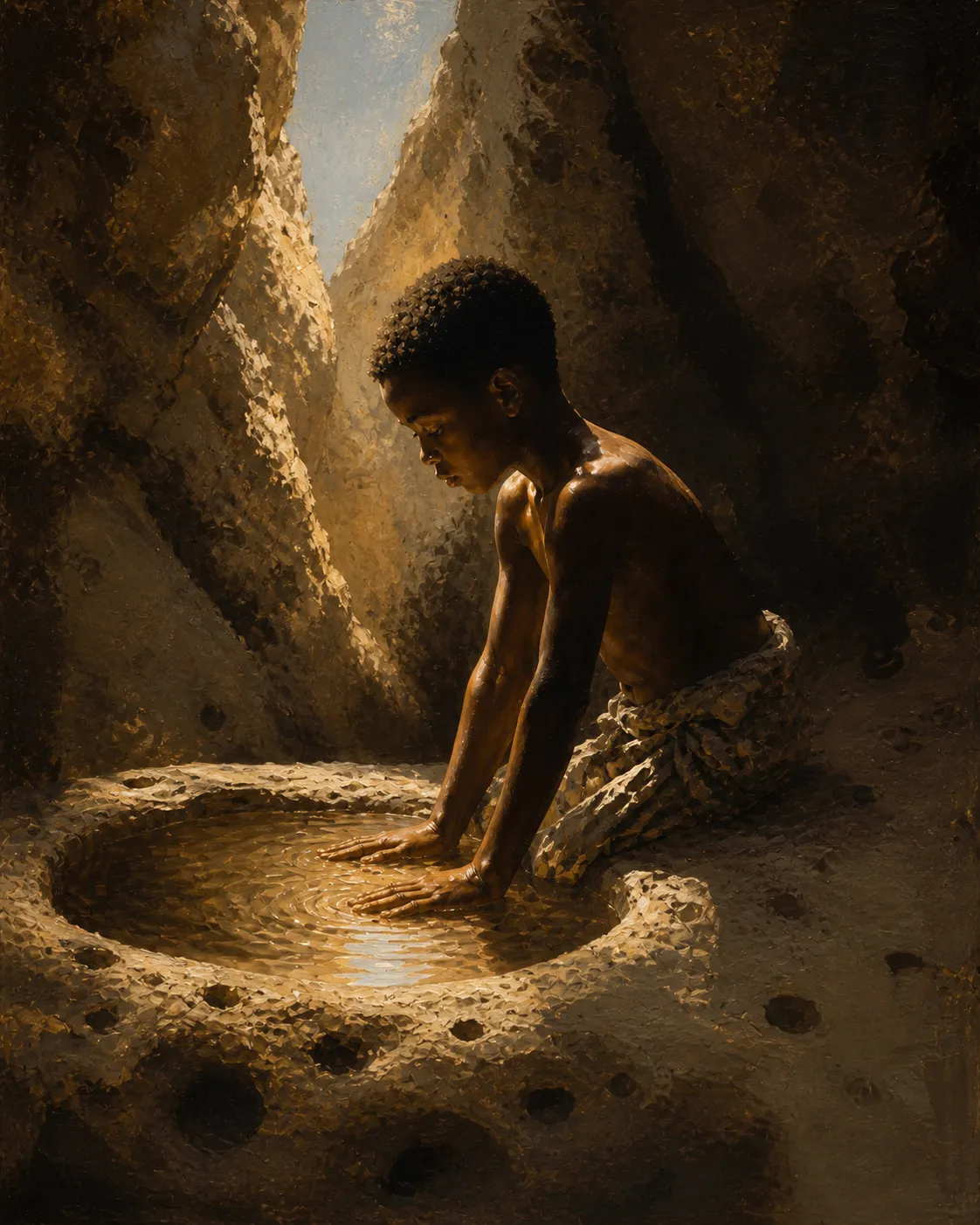
The basin was a hollow in the stone no wider than his outstretched arms. The water lay still in it — dark at the centre where it deepened, pale at the rim where it crept into the rock. Steam came off the edges where the morning sun struck.
He knelt at the lip.
The water tasted of the rock it came up through — iron, and the bitter mineral the dye-women drew from the stones above the river-bed. Undrinkable. He had tried once, as a small boy, and his mother had held his head over the cookstone basin for an hour while his stomach emptied itself.
You don’t drink it, she had said when he could speak again. The earth keeps that water for itself.
He stripped — sandals on the warm stone, wrap folded on top. The air on his bare skin, a brief shock. Then not.
He went in.
Cold. Always the cold first, sharper than the desert above let you believe possible. His breath went short. He lay belly-down over the basin with the water to his ribs and his arms held out and waited — and after a long moment the cold stopped being cold. It became the other thing. A kind of holding. The water pressed in from all sides and the pressure was even and the pressure was kind.
He closed his eyes.
The presence was already there.
Usually he had to wait — let the surface go still before the deeper thing rose from under it. Not today. Today it was already up. Already against him. The pressure at his belly, steady, and something behind it that he could not —
It came in through his chest.
Not sound. Not warmth. Something that had nothing to do with the water — pressing through him from inside, and his ribs were too small for it, and his lungs —
— grief —
The word arrived and was not enough. This went further down than grief. It was the shape grief made when it had been going on for a very long time and had not been heard. His hands wouldn’t move. His legs were somewhere behind him and they were not his.
The water held him.
He pressed back — the way he always did when the presence went deep, opening himself further, pushing toward whatever it was holding. It resisted. Gently. The way his mother’s hand had once covered his when he’d reached for something hot. Not warning. Keeping.
He pressed again.
The presence didn’t yield. It gathered around him instead — closer, warmer, fuller — and he understood, the way he understood north or thirst, that it was trying to hold him here. That there was something on the other side of its keeping that it did not want him to reach.
He pushed through anyway.
What came was not words. Only a direction — and within the direction, a weight he recognised from the inside of his own chest. The same grief. The same shape. Coming from where his village was.
Mama.
He opened his eyes.
The basin was as it had been. Clear water. Pale stone. Green scrub. The sun a hand higher than when he’d gone in.
He felt the presence pull. Stay. The keeping-hand again, gentle, certain.
He climbed out. Slipped on the lip. The warm stone scraped his knee. He didn’t stop.
He left the fold at a run.
The rock fell away behind him and the desert opened and he ran.
The sun was high — not midday, climbing — and the heat sat on his skull and pressed. He didn’t feel it. He felt the wrongness in his chest where the water had put it, and his legs going under him, and the ground.
He ran until his legs gave. Walked. Ran again.
The standing stones went past. The lizard was gone from its flat rock. He passed the thorn-tree where he’d stopped once a year ago to drink in the shade and he didn’t stop now.
The sky was empty.
He noticed it without noticing. The sky should have had the kite in it still, turning on its slow wings, or another like it. The sky had nothing. Pale and white and clean. A long way off, very high, something dark moved across it once and was gone.
Mama.
He ran.
The ground rose. He knew this rise. Beyond it, the village. Beyond it, the well and the cookstones and the thorn fence and the goats. He came up at a stagger, his lungs going, the wrap clinging to him with sweat, and at the top he stopped.
He stopped because his body stopped him. Before he had seen anything. Before his eyes had found the shape of what was below.
The smell.
He stood on the rise and breathed and the smell came up to him on the heat. He knew it. He’d known it since he was small — the village butchered goats, and he’d stood by his father once when he had cut a goat’s throat, and the blood had come out fast and the smell of it had risen, and his father had said that is the smell of meat, son, do not forget it.
It was that smell. Larger.
He didn’t want to look. He looked.
The village was below him. Still. The huts standing, most of them. One burning, low — the rope-maker’s hut, the thatch caved in, smoke rising thin and grey. The thorn fence down on the south side. A goat against the well in the dust.
Other shapes.
He didn’t let his eyes name them yet.
Nothing moved.
His legs went and he sat down. He sat in the dust with his hands open in front of him, watching them shake.
Get up.
He got up. He went down.
He went slowly. Running was for before. He walked down the slope and into the village and the smell got worse as he came down and somewhere inside him a small clean voice was saying mama mama mama very quietly and he didn’t listen.
The first body was Bekhal.
The old man on his back beside the goat-pen, arms thrown wide. His chest open. Whatever had opened it had taken most of what was inside and what was left was black with flies. The flies rose when Demessie stepped close and settled again. Bekhal’s face was untouched. His eyes open and surprised.
He stood and looked.
He couldn’t feel his hands.
He went on.
Asteri was by the rope-maker’s hut. She was very small. He didn’t look long. He turned his face away and into his hands, and he stood there for a long time, making no sound.
When he took his hands away the village was still there.
He went on.
The half-men. Three of them between the huts where they’d fallen. He’d never seen one this close — wings half-folded under them, taller than a man, the long hooked feet curled in death. The faces were bird where they should have been man, man where they should have been bird. Beaks open. Eyes yellow and filmed.
One had an arrow through its throat. One had a spear standing up out of its breast. The third had been killed with something smaller — a knife, maybe — and lay curled around the wound with its claws tucked in like a sleeping thing.
His father had been a good shot with the bow.
He stood over them and a thing in him with no name wanted to kick the bodies and he didn’t. He went on.
He went to his hut.
The cookstone overturned. The fire out. The clay dish broken in two pieces by the threshold. The iron pan on its side.
The door-skin was torn. He pushed it aside.
His mother was not there.
He stood in the doorway and looked into the hut for a long time. The place on the wall where the bar of light had been when he woke.
The bar of light was not there now. The sun had moved.
He turned, went out.
He moved through every hut. Slowly. In order — east first, then south, then west, then north. He didn’t call her name. He didn’t call any name. The half-men were not all dead and somewhere in the back of him he knew that and it didn’t stop him. It didn’t slow him.
He didn’t find her.
He found Tarêsh. He found old Ïmhal who’d lost his leg to a half-man two summers ago and walked on a stick. He found the two women from the well. He found Asteri’s mother, and Asteri’s father, and Asteri’s baby brother who had been born in the spring.
He didn’t find his mother.
He didn’t find his father either. His father had been out with the herd-boys. The herd-boys were nowhere to be seen. He went to the south end and stood at the broken thorn fence and looked out across the scrub. He couldn’t see them. He couldn’t see anything.
The sun had come down a hand from its highest. Past midday now.
Be back before midday.
He stood at the fence and his face didn’t move.
He stood for a long time.
Somewhere very far off, very high, a shape turned in the white sky on motionless wings.
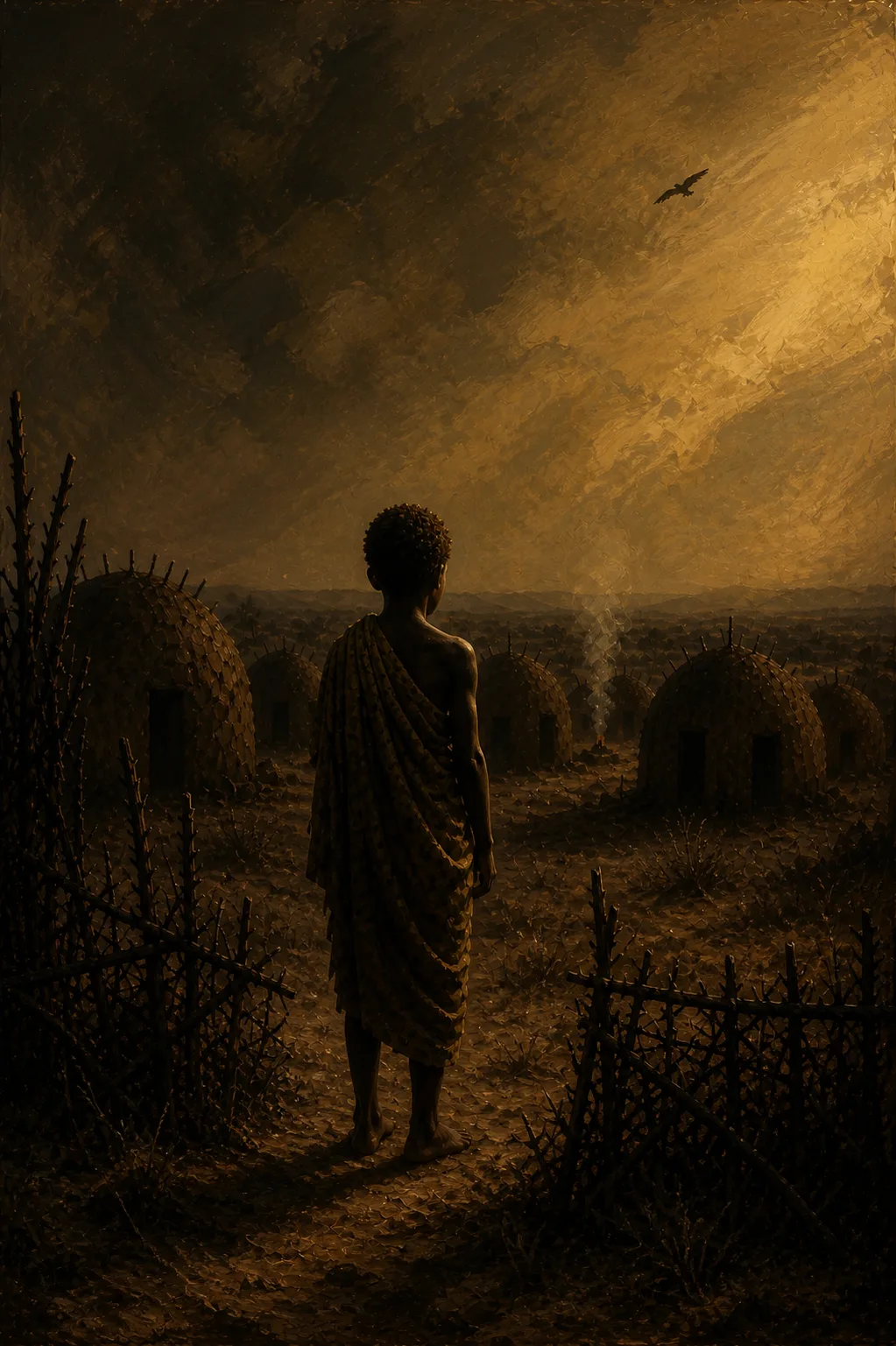
The sun moved on him. He felt it on the back of his neck where his wrap had pulled away. He didn’t adjust the wrap.
A fly landed on his hand. He didn’t move it. The fly walked from his thumb onto the back of his fingers and stopped there. He could feel its small feet. After a while it lifted off and went away.
The voice of the water was still in him.
He noticed this without having noticed it stopping. It hadn’t stopped. It had been there through everything — through the rise and the smell and Asteri’s mother with her empty arms. It had been there and he hadn’t heard it because there had been other things. There were no other things now.
He listened.
The voice was quieter than it had been at the spring. Further away. But it was there. The same voice. It had not gone.
Something in him moved.
He felt himself turn from the fence. Felt himself begin to walk.
He didn’t run.
He walked back through the village. Carefully. Not looking at the bodies now, looking at the ground in front of his feet. He went to his hut. Inside. He went to the place where he kept his things — a wooden box his father had made him, painted along the lid with the little red marks his mother had drawn there when he was four — and he opened it.
He took his knife. He took the small skin of water that was nearly full. He took the strip of dried goat his mother had wrapped for him last week and that he hadn’t eaten yet. The salt had gone white on the outside of it, drawing out in crystals the way it did. He held it a moment before he put it in his pack. He took the wool blanket.
He stood in the middle of the hut with these things in his arms and looked around once.
He went out.
He didn’t look at the bodies on his way through. He kept his eyes on the ground.
At the south end of the village he stopped at the broken fence and looked back once. The hut. The cookstone. The place on the wall where the light had been.
He turned south.
He walked into the desert.
Behind him, the sky above the village was empty. Ahead of him, it was empty too. He walked, and his shadow walked under him, short and black on the pale ground, and he didn’t weep yet, and he didn’t know where he was going.
The voice of the water was still in him.
It walked with him.