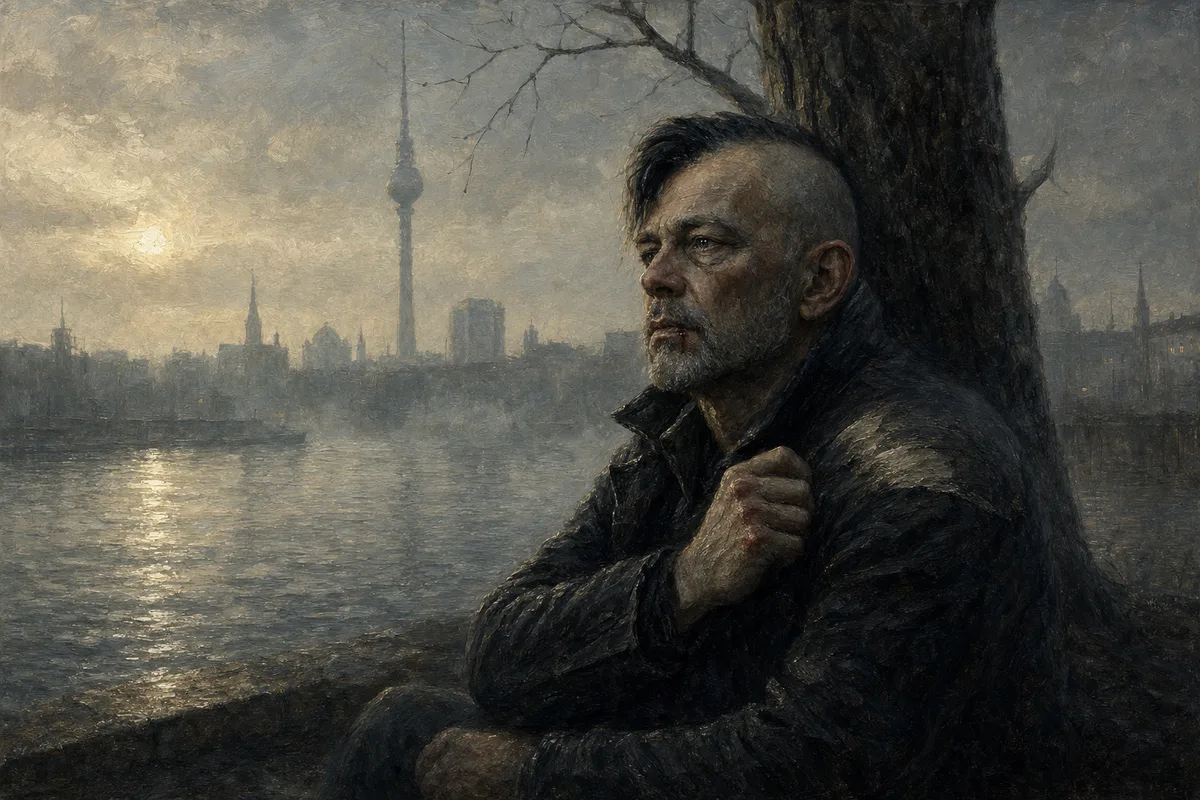
Light came through the gap in the curtain and landed square on Leon’s face. He lay under it with his eyes shut and let his body report in. Temples, throat, a shoulder that had hit something or been hit by it. Somewhere near his feet a stereo was still going, the Sex Pistols ground down to a scrape by whatever was wrong with the left speaker.
Whose place is this?
He’d come in behind a man called Micha, or Mischa, or possibly Mirko, who knew someone who lived here, and at some point in the night Micha-or-Mischa had gone without saying so. Fair enough. Leon wouldn’t have said so either.
He got one eye open. Three mattresses on the floor, and the couch under him, which had a spring in it he could feel through his jacket. A girl asleep across a heap of plaid blankets with one boot still on. Two men back to back on an unzipped sleeping bag, as if they’d fallen out about something and gone to bed on it.
The walls had been papered with flyers so long ago that the flyers had become the walls: benefit gigs, eviction demos, bands nobody under fifty had heard of. He’d seen half of those bands, and a couple of them had slept on floors he’d slept on. Nobody in this room would know that. It wasn’t the sort of thing a man could bring up at eight in the morning without turning into somebody’s uncle.
Bottles stood on every flat surface and lay on most of the others. Someone had used a hubcap as an ashtray and filled it.
He sat up. The couch complained. He put a hand to his head and found the mohawk crushed flat down one side where the cushion had been and still standing on the other.
Half a haircut. Suits me.
The kitchen was a strip of lino with a stove on it. A girl with a shaved head leant against the counter, holding the only mug that didn’t have something growing in it and picking with her thumbnail at a rose tattoo that had gone half to scar. She looked at Leon, at the coffee pot, back at Leon.
‘Any more of that?’
‘No.’
He found a jar of instant behind the bread bin, knocked the last of it loose against the heel of his hand and ran the tap until it went from cold to slightly less cold. It tasted of nothing much, which was an improvement on his mouth.
The speaker took him a quarter of an hour. Not under the couch, not behind the door, not in the bathroom, where a man in a Crass shirt was asleep in the dry bath with his arms folded like a pharaoh. If he’s got it, I’ll have him embalmed.
He found it in the end under a slumped stack of flyers by the radiator: grille dented, stickers lifting at the corners, the duct-tape strap stiff with something he decided not to smell. It weighed about the same as a crate of beer, and he’d carried it across Berlin more times than he’d carried anything, including, on one bad night, a girlfriend. He’d walked out of whole squats with less fuss than he’d just made looking for it.
He pressed the power button with a chipped black nail. Static, then the Circle Jerks, ‘Wild in the Streets’, at the volume he’d left it on, which was all of it.
The girl in the blankets sat bolt upright. One of the men on the sleeping bag threw a boot and missed by a metre. Somebody in the bathroom shouted something that was mostly vowels.
Leon grinned, and his lip split again. There you go. Morning, everyone.
He pulled a plastic bag off the hook behind the kitchen door and went round the room with it, green bottles and brown bottles and the big plastic ones from under the sink, doing the sums as he went. Quarter each for the plastic. Glass, next to nothing. Still breakfast.
‘They’re not yours,’ said the girl with the tattoo.
He shrugged, knotted the handles and slung the speaker over his shoulder. The door shut on his heel, and a second later he heard the bolt go across.
Saturday, and cold enough to hurt his teeth. Across the road stood the building where he’d once spent two winters with no glass in the windows, burning broken doors in an oil drum in the courtyard and arguing about whether the oil drum counted as property. It had a brass plate by the entrance now, and window boxes full of little clipped trees.
The coal merchant’s on the corner was all glass, and behind the glass people sat on wooden benches eating eggs on bread that cost more than his boots. Leon had lived across from that coal merchant for two years and never once seen the man smile, and he found, standing there, that he missed him.
He turned the volume up.
A woman pulled her little boy closer by the hood. A man in a good grey coat tapped his own temple and said, ‘Geht’s noch?’ and Leon gave him the full grin back.
Look at them. Look at them hating it.
It was better than the coffee. Every scowl told him he was still here, still the thing people crossed the road to get away from, and if they ever stopped crossing the road—well. They hadn’t yet.
The Lidl by the U-Bahn had a queue for the bottle machine: one old man in a cap with a trolley of empties and all the time in the world. Leon stood behind him with the Circle Jerks going and watched him feed in his bottles one at a time, waiting each time for the belt to carry one off, then offering the next. The old man didn’t look round once. Leon respected that.
When his own turn came he went faster. The machine took the glass with a clunk and the plastic with a crackle, and then it reached a brown bottle with the label scraped off and spat it back. He put it in again. It came out again.
‘It won’t take that one,’ said a woman behind him, with a bag of her own.
‘It’ll take it.’
It didn’t. Leon stood the bottle on top of the machine like a small monument and pressed the green button, and a receipt came out about the length of his finger. He held it up to the light as though it might be forged. At the fridge it came to four cans of the cheapest Pils and not a cent more. He took it as a sign.
At the till the security man came over with his hands up and his mouth going, and Leon watched the mouth open and shut while ‘Too Drunk to Fuck’ set the chewing-gum rack rattling. Not a word got through. Leon turned it down one notch, as a gesture.
In the next queue a little girl in a yellow coat had hold of her father’s sleeve and was nodding along, not with her head but with all of her, knees and shoulders and the pompom on her hat. Her father put a hand over her ear and turned her face towards the sweets. She turned it straight back.
Leon winked.
She stuck her tongue out, right out, as far as it would go.
Best conversation I’ve had all week.
He drank the first can on the steps outside and the second on the walk, and kept the other two in his jacket, where they knocked against his ribs like they had somewhere to be.
The Crow Bar had a real crow, stuffed, on a shelf above the till. It had lost a glass eye some time in the nineties and nobody had replaced it, so it watched the room side-on, like a regular who’d heard all the stories before. Black walls, and a floor that held on to his boots. Minor Threat was already playing, ‘In My Eyes’. Leon set the speaker on the stool beside his and slapped the wood.
‘Fucking tune.’
‘You say that every time,’ said the barman.
‘It’s a fucking tune every time.’ Leon laid his hands flat on the bar. ‘On the board.’
The barman looked at the board behind the till, where LEON had been chalked so long ago that the chalk had gone into the paint, and pulled him a pint without a word.
Two regulars sat further along, a man with a grey ponytail and a woman in a leather jacket so old it had gone soft as a glove. The woman had watched the business with the board, and when Leon’s pint came she lifted her own glass an inch towards him, and that was all the opening he needed.
‘Washington,’ he said. ‘Nine-thirty Club, eighty-one. Couldn’t lift your arm to wipe your face. Walls running wet. Floor going up and down under you like the deck of a ship.’ His hands were up, shaping it for them, the low ceiling, the crush. ‘Came out of there with somebody’s blood on your shirt and you didn’t care whose.’
He was grinning so hard his lip opened again. He licked it.
‘Furnace,’ he said. ‘Proper furnace. You had to be there.’
‘Were you?’ said the woman.
‘What?’
‘There.’
‘Course I was there.’ He drank. ‘I’m telling you about it, aren’t I?’
What he remembered, when he let himself, was mostly the after. The pavement outside, steam coming off everybody the way it came off horses, and all of them peeling away in twos and threes towards cars and somebody’s brother’s place, and Leon standing there with his shirt going cold on him, working out which way the bus was. He never told that part. Nobody had ever asked for it.
The ponytail said that was mad, that was really something. Then his phone went. He held up a finger, took it by the door with his other hand over his ear, and came back looking grey.
‘Landlord.’
After that it was the landlord, and the heating, and a company in Luxembourg, and the woman’s sister in Neukölln who’d had the same letter. Leon sat with his mouth half open, waiting for the gap. It didn’t come.
‘There was this squat in Kreuzberg,’ he said, ‘had a horse in the yard—’
The barman put a different record on. The woman turned. ‘Sorry, what?’
‘Nothing.’
Bakunin. Nobody ever asks the horse’s name.
He stayed until the windows went dark. The speaker sat on its stool the whole time, and nobody asked for the stool.
The warehouse was out east past the railway, down a black metal staircase that rang under his boots, and the bass came up through the handrail into his palm. At the bottom a woman with a cash box and a stamp said ten, or whatever he could manage. Leon had drunk the third can on the S-Bahn. He took the last one out of his jacket and stood it on the lid of the cash box. She looked at the can, then at the speaker, then at him, and stamped the back of his hand.
Inside there were a few hundred people, maybe more, and a stage made of pallets. He propped the speaker against a pillar by the bar where he could keep an eye on it and went to find the pit.
A band he didn’t know was halfway through a song that sounded like someone falling downstairs on purpose. He went in shoulder first. The first hit knocked the breath out of him and he laughed with what was left.
A skinny boy who couldn’t have been eighteen went down face first at his feet. Leon had him up by the collar in one pull and shoved him back into it, and the boy came up grinning with blood running out of his nose and didn’t look round.
Leon’s first winter going to gigs, a man in a Bad Brains shirt had hauled him up off a cellar floor by the belt and gone straight back into the crowd without a word.
This. This is mine.
Late in the set the band dropped to half speed for a few bars and then came back twice as fast, and the pit came with them. Something caught Leon behind the knee. He went down hard on one hip.
Legs. Nothing but legs, jeans and bare shins and boots going past his face, the stage lights coming through the gaps in bursts. He put a hand up and held it there.
Come on.
A boot came down on his fingers and lifted away again. The song kept going.
He got one foot under himself, then the other, pushed off a stranger’s back and threw himself into the middle of it again, head down, as hard as he could.
‘Who’s that?’
The bottle was pointing at his chest. Leon had been at the bar since the band finished, back to the pillar, boot touching the speaker, shirt stuck to him, his swollen fingers wrapped round a plastic cup somebody had abandoned with an inch of beer still in it. There were four of them. Their jeans had been torn by somebody who was paid to do it. The one with the bottle had a mohawk that had taken longer than Leon’s, gelled into points so neat they looked moulded.
Leon looked down. The shirt was older than the boy. The print had gone grey and cracked, and the name was barely there. He’d bought it off a trestle table in a cellar where eleven people had turned up to see them, and he’d been one of the eleven.
He told them.
‘Never heard of them.’ Big laugh. The mohawk got his phone out, thumbed at it, held it up. ‘Nothing, man. There’s nothing. Are they even real?’
‘They were real,’ Leon said.
‘Were,’ said the mohawk, and the others thought that was the funniest thing yet.
It started somewhere under his ribs and went up through him like flame up a curtain, far too fast and far too big, and some small sensible part of Leon watched it go and didn’t care. He slapped the phone out of the boy’s hand. It skidded away under the bar. He got the leather jacket in both fists, soft and new and still smelling of the shop, and pulled him in until their noses nearly touched.
‘Who?’ Leon said. ‘Where were you in eighty-one?’
The boy’s mouth opened.
‘Nowhere. Not born. Your dad wasn’t shaving yet.’ Spit flecked the boy’s cheek. Leon watched it land and kept going. ‘People got their heads opened in rooms like this. So you could stand here in your four-hundred-euro jeans—’ he shook him, and the neat points of the mohawk wobbled ‘—and ask me who.’
The boy wiped his cheek with the back of his hand and looked at it.
The beer came first, from the side, full in Leon’s face and into his eyes. Then a fist, then two, and he swung blind and hit something that crunched, and somebody got him round the neck from behind. He was older than some of their fathers, and there were four of them. He went down for the second time that night, and this time the boots came looking for him.
The bouncers waded in while the four of them were still at it. One on each arm, his heels skating on the wet floor. He twisted round to look back at the pillar. ‘My speaker—’ The bigger one put a hand flat on the back of his head and pushed, and a fire door banged open, and the cold came in, and Leon was face down on the cobbles of an alley with the door swinging shut behind him.
He got up and hit it with the side of his fist. ‘My speaker’s in there!’
The bass came through the brick. Nobody opened the door.
Some little shit’s got it already. Course they have.
He must have slept, because the next thing was grey light in the gap between the roofs and his whole left side gone stiff against the wall. His lip had stuck to itself, and when he opened his mouth it tore. He checked himself in the order he always did: hands, ribs, teeth. Two fingers swollen fat. A rib that caught on every breath. Teeth all there.
Still got the teeth. Teeth’s something.
The door was shut and the music had stopped. He didn’t try it.
He walked, because there was nothing else to do with his legs. The streets were empty except for a sweeper truck and a man walking a small dog that was better dressed than either of them. Without the speaker his right arm didn’t know what to do with itself. It kept coming up to his shoulder to steady something that wasn’t there, and every time he caught it doing it he put it back in his pocket.
He’d carried her on that shoulder once, before the speaker had the job, the whole length of Oranienstraße at four in the morning, her knees hooked over his arm and her boots knocking his hip, singing something filthy at the shop shutters. She’d been lighter than he expected.
Don’t.
The arm came up again. He let it.
The road went downhill, so he ended up at the river. The Spree was the colour of a dirty knife. Under the trees along the bank someone had pitched a green tent with the flap tied back, and in the open doorway sat a man with a sleeping bag pulled up to his chest, a cup in one hand and a little radio on the ground beside him. The radio was playing Schlager. An accordion, and a woman singing about a summer somewhere warm.
Schlager. Course it is.
The man looked up. He had a grey beard and a hat with the pompom gone.
Leon nodded.
The man nodded back, barely, and went back to his cup.
Leon sat down on the low wall a few metres along with his back to a tree. The stone was freezing through his jeans. He took his hands out of his pockets, looked at the swollen fingers, and put them back.
The song finished and another one started that sounded much the same, a man this time, something about a beach. Leon knew this one. He’d heard it through a kitchen door more times than he could count, her voice going along under it, and every time he’d gone in and switched it off.
The river went past. Upstream a tram crossed the bridge and its bell carried down over the water.
Leon didn’t ask him to change the station.