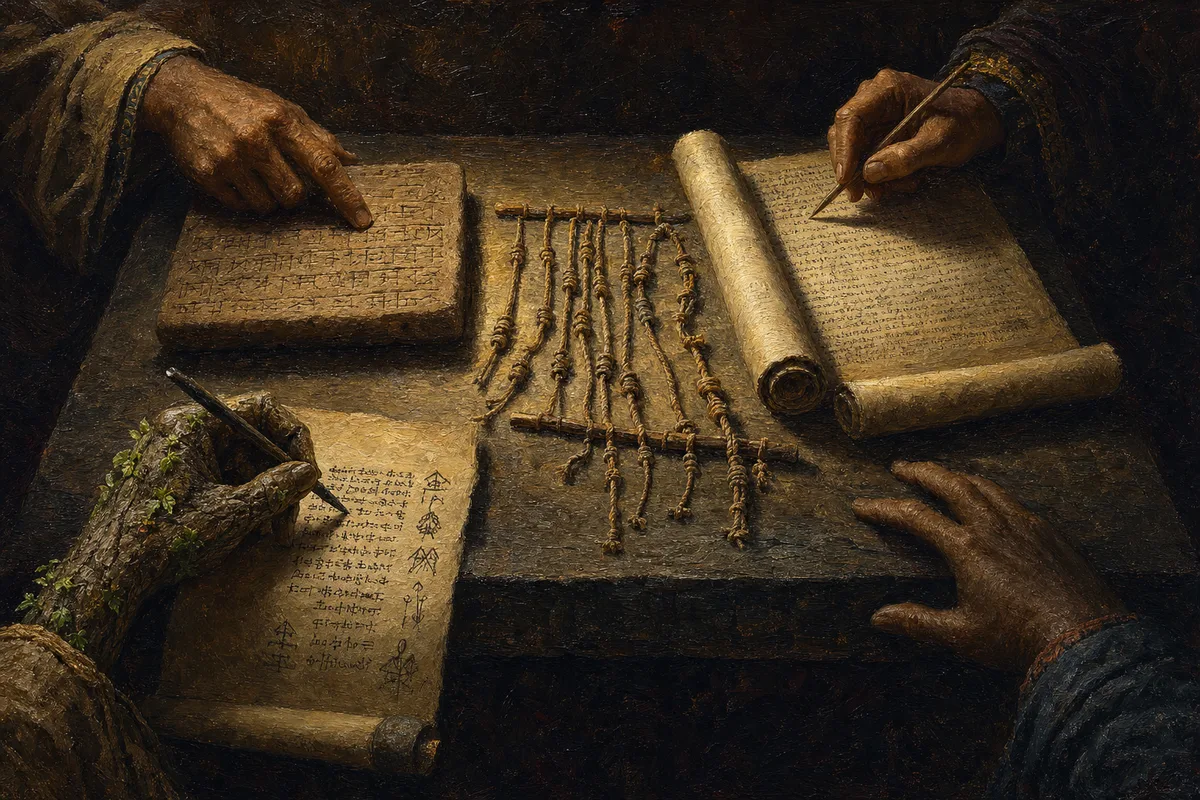
The problem with world-spanning prophecy is that it tends to hand the story to one people. Pick one set of priests as the true receivers, and every other civilisation’s religion quietly becomes folklore — backdrop for the story that’s already decided who it belongs to. I tried building Tuith that way, and kept running into the same wall. An ancient world with many peoples has had a long time to listen. What I eventually worked out was that they’d all heard something true.
Part of what drew me to this design is that it’s not only a narrative solution. It’s a conviction I hold outside the fiction: that every people who has genuinely reached toward the divine has received something real. Partial. Shaped by their history, their formation, the things they most needed the divine to be. Not degraded copies of some purer original — true receptions, carrying what the culture was capable of holding. I found a world where I could build that in, trace the mechanism, watch the partial truths diverge and converge. That was the invitation.
Every people that has ever listened has caught a genuine piece of the signal — shaped by their particular wounds and desires, by who they are. The Ifmari, who understand the divine as pure power, receive a prophecy that crowns power. The Shira, living close to the root of things, produce the clearest single formulation — but it remains one angle of the truth. The full shape only becomes legible when all the traditions are laid alongside one another, and no single civilisation has ever stood in a position to do that — which is the point. Desire is always the lens. Every people heard through what they most needed the divine to be, and a lens held at the wrong angle can miss the object even when the glass is clean.
The name the Shira tradition settled on for the central prophetic event is the White Throne, and it became, across centuries, the standard cross-cultural scholarly designation — not because the Shira are the oldest or the deepest, but because their crystallisation gave the event the clearest form it had ever received. It stuck for the same reason any good name sticks: precision, not priority.
The Silmarillion was what I kept returning to as a template — Tolkien giving multiple peoples their own relationship to the same divine history, each independent, all converging. The ambition here is something in that order, focused specifically on prophetic tradition. Multiple peoples, multiple priesthoods, multiple genuine readings, all partial, all converging on a moment none of them can see clearly from inside their own tradition. Whether the execution earns it is a question for readers. What the structure gives me in the meantime is something I couldn’t have simply engineered: a world where every civilisation is a real witness to the same truth, rather than a footnote to someone else’s.
While Shadows Weep introduces the traditions without assembling them. That’s not structural convenience — it’s what partial knowledge looks like from the inside of it. The assembled picture, if the series earns it, won’t belong to any one people. It will belong to the space between them.