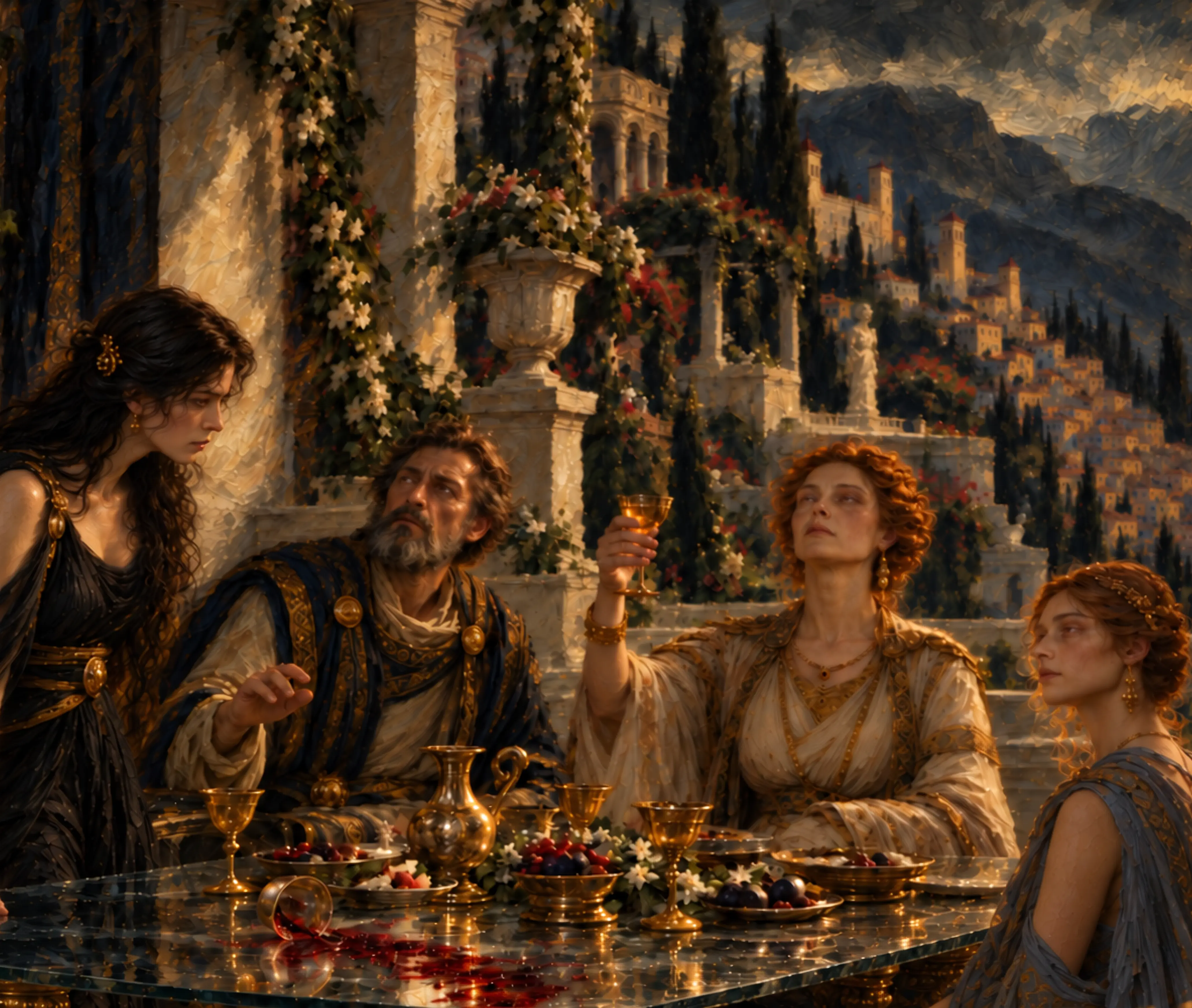
Screams slid across a smooth glass surface. They were her mother’s screams. Why is Mother screaming? The glass cracked, a single fissure travelling out across it—and in the splintered reflection, violet eyes that were not her own studied her.
The screams came again. The fissure spread. The glass gave way and fell in glittering pieces into the dark.
The screams thinned into a droning hum—and inside that hum marched soldiers, thousands upon thousands of them, every foot coming down at once.
Meda woke to daylight through her window.
Butterflies turned beyond the pane, this way and that, as if no direction felt right. Golden wings beat once, twice, and they were gone.
Below her walls, grounds-workers strung garlands through the terraced gardens. Past them Aur fell away down the mountain in white stone to the harbour, where the morning boats were already going out, and to the east the jungle ran green all the way to the hills. A bell tolled. Once, twice. Just a test. Tomorrow it would ring for her.
‘Princess?’
Harliko stood at her elbow—olive-skinned, nineteen like Meda, with warm dark eyes.
‘You’re worrying again,’ Harliko said. ‘It will be fine.’
‘It’s not that.’ Meda raised her voice to the maids bustling about her sleeping quarters. ‘Tea, please.’
She inspected her nails for a while before she looked up at her new handmaid. ‘I’m going to miss this. Home. Them.’
‘You’ll love it there, you’ll see.’ Harliko said it the way she had said it a dozen times that week.
Anne set a steaming cup of chai down on the table beside her. ‘Aur will always be your home, Princess. You can come back whenever you like.’
Meda smiled up at her. Anne had been with her since they were both girls, Aur-born and steady as a wall, and she made no secret of what she thought of Harliko. Harliko is here to get me ready for him, Meda thought. That’s all.
She had wanted to take all her handmaids with her to Leo’s house. Her mother had said it would not look good.
To whom? Meda had snapped.
‘You go to his house as his wife. Aur will still be yours when the time comes. Until then, a leader cannot do whatever she wants.’
The memory pulled tight across her ribs, like the stays at her last fitting. The room tilted. Cracked earth under a bruised sky, grey and barren, running on and on to nowhere. She lifted the cup, shut her eyes and breathed over it until the pressure eased.
The vision drained away. Not now. Not today. Not ever again.
The room came back—the chink of a tray, the snap of a sheet shaken out. Her maids had gone on with their work.
When she opened her eyes, Harliko was watching her. She misses nothing, this one. Meda set the tea down untouched and stood.
‘I need some air.’
She was through the door and had shut it behind her before any of them could follow.
Sir Humfrey Lyonal bowed as she passed. Meda ignored him and went to the balcony above the stone steps of the Eternal Keep, gripping the lattice rail until her knuckles whitened.
Her shoulders came down by degrees. Below, servants were dusting vases and scrubbing the foyer floor. Everything ticking along as it always did.
She turned back for the door, and the sound came again—low, thrumming. The hum from the dream. It was louder now, and it made her teeth ache. She looked about for the source and saw nothing.
Surely someone else can hear that?
Downstairs the servants carried on scrubbing. No one looked up.
Her gaze went to a high window. Above the eastern hills, a shimmer wavered in the air—heat without heat.
‘Princess!’
An old man was coming along the balcony towards her. When she looked back at the window, the shimmer was gone. Only jungle, and the hills.
‘Are you all right, Princess Meda?’ He was close now, and frowning. She met his clear grey eyes and lowered her head before she had even thought to. Guardian of Aur, the old histories called him. These days he was only the Patriarch, and blessed weddings.
‘Patriarch Naleren. I’m quite fine, thank you.’
‘Quite fine, eh?’ He looked her up and down, unconvinced, and picked a crumb of dirt from under his thumbnail. ‘Well. I suppose anyone’s allowed to be jittery the day before her wedding.’
‘There’s no hiding from you, is there, Patriarch?’
‘Ha! Naleren, please.’ His smile went all the way up into the lines around his eyes, and she felt safe in it. He’s like me … but I have to hide what I can do.
Naleren winced. ‘So do I.’
He looked startled, as though he hadn’t meant to say it aloud.
‘I’m sorry?’ Did he just—how could he?
‘Forgive me. I spoke too far.’ He laid a hand on her shoulder. Behind her, Sir Humfrey’s armour rustled.
‘You needn’t worry.’ The amusement had gone out of his face. He seemed taller all at once, broad through the shoulders, his white beard spilling down over his cream robes. ‘Never forget. All will be well. Trust in the God.’
She wanted to ask him to walk with her in the gardens, to tell her what to do with the things she saw—but there was no time. Why didn’t I go to him before? All these weeks chasing flowers and fittings.
‘Will you be coming tomorrow?’ she managed.
The amusement came back. It usually did. ‘I wouldn’t miss it for the world, Princess.’ He pressed his thumb hard against her forehead, just for a moment, and something snapped against her skin like a spark off a wool blanket. ‘Keep your eyes open, Meda. No matter what happens, keep them open.’
Then he was gone down the stairs, his robes swaying after him. The spot where his thumb had been went on tingling.
‘I didn’t like the way that old creep touched you, Princess,’ Sir Humfrey growled from his post by the door. He had both hands on the pommel of his sword—a pose Meda suspected he practised in his chamber.
‘It was fine, Sir Humfrey.’
‘Got to be careful round that one. Ethradai or not, he’s a mage. Any other man with his tricks would’ve hanged years ago.’
The word went through her the way it did at every Teccimi sermon, when the priest reached it and the whole congregation went still.
Mage.
Don’t draw attention. Not to this. Not ever. Stepping back into her quarters, she knew that was why she had seen so little of the Patriarch these past years. And why I can’t see more of him now.
Meda took her time through the long hallways of the Keep in a simple black dress, heels tapping on the stone, Harliko and Anne a pace behind. They would wait on her at her last dinner with her family; the rest of her maids were drawing a bath for when she came back.
Her sister Lucille swept out of an archway, radiant as ever, and hooked Meda’s arm.
‘Oh, sweet sister, I’m going to miss you terribly.’
Meda gulped loudly enough to be heard, and they both burst out laughing, their laughter carrying past the kingsguard at their parents’ door and out into the garden pavilion.
‘Why are you sitting there like that?’ Lucille demanded.
‘Like what?’ Queen Felicita held the king’s hand in one of hers and an oversized glass of white wine in the other, and took a long swallow from it.
‘Like you’re waiting for a funeral,’ Meda said.
Her father shook his head. ‘Our eldest leaves us tomorrow. Aren’t we allowed to be a bit blue?’
No, because then I’ll be blue too, Daddy.
Lucille tugged her down into a chair. ‘Oh, come now, Papa, she’ll be back.’ She waved the server away from her glass.
The king grunted and sat back in his heavy oak chair at the head of the glass table. A warm wind stirred the grey hair on his forearms, and his rings caught the sunset. Meda let herself look at him—the bulk of him, the way a room arranged itself around him without his asking. Spencer Borogis, King of Aur, the heralds would cry tomorrow, and a string of older titles after it that took them a whole breath.
To her, he was and always would be Daddy.
He said the evening blessing the way he always had, too fast, his eyes already on the bread. Halfway through, Lucille kicked her under the table, as she had every night since they were small, and Meda kept her face straight and said the words along with him. She had said them every night of her life.
‘Daughter,’ her mother said. ‘Are you feeling well? You look quite pale.’
‘Paler than usual,’ said Lucille.
‘Yes, Mother. Just nerves.’
‘Nerves? You’re a Borogis. We don’t get nervous.’
‘Felice,’ said her father.
The talk moved on without her. Leo will be at dinner with his family now. Their last one alone. After tomorrow I’ll be at that table every night. Leo’s father was dead, so Leo would sit at the head of it. And who at his right hand? His mother, or his wife?
‘Well, we are very proud of you anyway,’ her father said, and he meant it so plainly that she nearly cried at the table. She could only look at him.
‘Aur has needed friends since the revolutions,’ her mother said. ‘Leo’s house will make us strong again—and make your reign safe, when it comes.’
Meda frowned into her plate. Talking about my reign in front of Father. Honestly, Mother.
‘To Meddie and Leo!’ Queen Felicita lifted her nearly empty glass, and a servant filled it while it was still in the air. ‘May they live happily ever after!’
Meda reached for her own glass, and something struck the inside of her skull. Thump-thump. Wet. Rhythmic.
She clapped a hand to her head and knocked her glass flying. Red wine sheeted across the table towards her father—and for a long moment it was blood. It ran off the edge of the glass into his lap. It was coming from him. Above his collar his throat had gone black, and still the blood came.
‘Daddy—’ She was on her feet, chair scraping. ‘Daddy, your throat. Your throat—’
He looked down at himself. Wine. Only wine, dark on his shirt front, dripping from the edge of the table.
Nobody spoke. The servant with the jug had stopped where he stood.
Lucille laughed, a small bright sound that went wrong halfway. ‘Meddie?’ She drew her hands back off the table and into her lap.
Her mother’s eyes went to the servant with the jug, and to the kingsguard at the door, and came back to Meda. Her face had gone white under its paint.
She knows. They all know. They’ve seen.
‘Sorry, I—’ Meda sat down again, carefully. ‘I felt faint.’
‘Meda.’ Her father was half out of his chair, one hand already reaching for her across the glass. ‘Meda, love—’
Her mother turned, too quickly, and chinked her brimming glass against the silver chalice by his plate. ‘To Meddie and Leo,’ she said again, loudly, to the servants and the kingsguard and the evening air. She did not take her eyes off her daughter.
A chime rang out—from no glass Meda had ever heard. The air itself sang, and the world slowed to syrup.
The chime went through Meda the way the hum had all day, but it found nothing to hold on to.
Her mother’s face had stopped, halfway to whatever it had been about to become. Her glass stayed up in the air where she had raised it. At the head of the table, her father sank slowly back into his chair, his hand still out across the glass towards her, and his bright blue eyes went dull.
Is this another vision? It didn’t feel like one. Her head was clear.
Lucille swayed in her seat with her hands in her lap, her smile sliding, bit by bit, into something like a grimace. Her eyes glazed.
Around the pavilion the servants stood where they were, jugs and dishes in hand, staring at nothing. Meda pushed her chair back and stood. The chime was still ringing.
All day she had heard the hum, and no one else had. Now no one else could hear anything at all.
Somewhere far off, voices were shouting—short, clipped words in no tongue she knew.
Her mother’s glass slipped from her fingers, bounced once on the table and smashed on the flagstones. Then her father’s chalice, clanging against the stone.
Meda backed into someone. Harliko and Anne stood side by side, swaying a little, their eyes turned up to the sky. ‘Anne?’ It came out a whisper. ‘Harliko!’
Neither of them so much as blinked.
Meda doubled over and was sick on the stone. A tower bell tolled once and stopped. More shouting, nearer. Boots—a great many of them, all coming down together. Not the kingsguard. The kingsguard had never kept step in their lives.
She wanted to shut her eyes. To make it a vision, and wait for it to end.
Keep your eyes open, Meda. No matter what happens.
She kept them open.
Black-armoured figures were pouring into the Keep. She saw them through the windows and the open doors, more and more of them, walking between the frozen servants without breaking stride. Four burst through her parents’ rooms and out onto the pavilion, long, thick spears in their fists. Where are the kingsguard? Where is anyone?
She looked for somewhere to run. They were on her before she found it. They dragged her down, screaming, and as she twisted in their grip she saw the faces inside their helmets, and they were not men’s faces.
The skin was grey as slate and close-grained as kid leather, the eyes dark and oddly shaped. She had seen features like that in the scrolls in her grandmother’s room—Hoq, the waste beyond the jungle, and the savages who lived there, drawn black and snarling in the margins to frighten children into bed. Ifmari.
Violet dust crusted the rim of the nearest one’s nostril. His pupils were blown wide, and his face hung slack as a sleeper’s—but his mouth was grinning.
‘The Queen wants her alive,’ he whispered.
‘And here she is,’ said another. His grip on her arm loosened as he swung round and bowed to the ground. A tall woman had appeared on the pavilion behind them.
Twisting against the arm round her throat, Meda saw a black gown sweeping the stone, lined in purple silk. Where skin showed, it was slick and metallic, veined with violet.
‘Let me see her.’
They wrenched Meda round and threw her to her knees. She looked up.
Violet eyes. The eyes from the glass.
‘The little seer.’ The woman looked Meda over the way Meda’s mother looked over a bolt of silk the drapers brought up for her. ‘You’ll have seen me coming, I expect. Good. Then you can be of use.’
‘What—’
A soldier backhanded her. The others laughed. The woman didn’t so much as blink.
‘This one doesn’t know how to conduct itself before Lamurasa,’ the soldier spat, ‘Queen of the World, Empress of all Ages.’
Meda’s face throbbed. She hardly felt it. Her mother was sliding off her chair and into her father’s lap, face-down.
Lamurasa followed her gaze. ‘That your parents, is it?’
A tear ran into the corner of Meda’s mouth. She shut her eyes. A vision. Just a vision. It won’t happen. I’ll wake up. Please, God. Please. Let it be over.
Keep them open.
She opened them.
Lamurasa walked over to the table and took her mother by the hair.
‘No!’ Meda threw herself forward, and for one moment her fingers closed on her mother’s sleeve—then they hauled her back, and a spear butt drove into her ribs. She folded over it with no breath left to scream.
Through her tears she saw Lamurasa bend and say something in her mother’s ear. Queen Felicita stood. She looked almost herself—except that her eyes were still glazed, and sunk deep in her face. A long, low moan came out of her.
‘There,’ said Lamurasa, and let go of her hair. She looked down at her hem. ‘Your garden’s filthy. Clean my dress.’
Queen Felicita dropped to her knees and began picking the dirt from the train of the gown. She did not stop moaning.
‘Please!’
‘Please,’ Lamurasa said, as though tasting it. ‘What’s your name?’
‘M-Meda.’ She couldn’t take her eyes off her mother’s hands.
‘Meda.’ Lamurasa turned it over and set it down. ‘No. Somebody chose that for you. I name my own things. Maggie will do.’
Maggie. A name for a child. For a dog.
Someone else was crossing the lawn towards them with seven soldiers at his back, and the tallest of the seven came only to his shoulder. Lamurasa turned to meet him with the smallest tilt of her head, and the stone at her brow caught the last of the light.
‘This the one?’ He brushed past her and took Meda’s chin in his mailed hand. The fingers were too long, jointed once too often, and cold through the mail. Bone showed through the torn grey flesh of his face, the brow-ridge bare and yellow as old ivory, and his eyes were two pits with something far back in them, looking out.
‘Yes, my lord,’ said Lamurasa. ‘She will be of great use to us.’
He let go of Meda’s chin. He had already stopped looking at her. ‘Then bring her. We’re leaving.’
‘My lord?’
‘Nothing here worth having.’ He was walking back into the palace, his guards closing round him. ‘The old Ethradai scampered off before we could catch him. Took the fucking stone too.’
Lamurasa’s nostrils flared, and her hands balled into fists. Then the Queen of the World, Empress of all Ages, gathered her skirts and hurried after him. The soldiers took Meda by the scruff of the neck and dragged her along behind.
‘No!’ She screamed it back at her family, still as statues round the dinner table. Her mother knelt in the grass, picking at the ground as though the gown were still there.
Lamurasa stopped. She looked at Meda, wailing on her knees; then at the table.
‘You’ll wear yourself out looking back, Maggie. Let me make it easier.’
She raised one finger and began to chant—a harsh, jagged language, hawked up from the back of the throat. Green smoke licked from her fingertip and split into lashes that cracked across the table. Her father’s head fell back, his throat blackening like a bruise.
His throat. I saw his throat.
Lucille slumped forward into the remains of dinner. Through the glass of the table Meda saw her foot jerk once against the leg of the empty chair beside her, and then be still.
Harliko and Anne swayed where they stood.
‘You can keep your maid.’ Lamurasa flicked a finger at Harliko. ‘Everyone ought to have something to look after. It keeps them tidy.’
Harliko walked over to stand beside Meda, vacant-eyed, droning the same low moan as her mother. Anne stayed where she was, swaying beside the ruined table.
Queen Felicita rose from the grass and walked past her daughter without a glance, and went to stand at Lamurasa’s side.
‘She’ll stay with me,’ said Lamurasa.
Father. Lucille.
The pavilion tipped.
Mother’s gone too. That’s only her body.
‘You’ll disappoint me, Maggie. Everyone does, at first. And when you do, I’ll have her to hand.’
‘Please—don’t hurt her!’
‘There. You’ve understood. Now come.’
Lamurasa turned for the doors. The guards shoved Meda after her, and Harliko followed—or what had been Harliko. Meda looked back once. Her father’s hand, still out across the table towards her empty chair. Lucille’s hair in the remains of dinner. Anne, alone, swaying in the last of the light.
A soldier pushed her on through the castle. She felt nothing. Her mind had gone quiet and white. Shock, perhaps. Or mercy.
In the great hall, where her father received guests in winter, people lay all over the floor. Breathing. Eyes open, seeing nothing.
Out in the streets it was the same. People lay where the chime had found them, on steps and in doorways, or stood swaying in the road with their market baskets still on their arms. Smoke rose from the lower city. Ifmari held every corner, spears raised, and bowed their heads as Lamurasa went by.
Keep your eyes open.
She made herself look. Whatever the chime had done, it had done to all of Aur at once, and these had come in behind it. Not one of them stumbled. Not one of them swayed. At every corner the same violet dust, the same blown eyes, the same easy grins—and at every corner an order called once in that clipped tongue and passed on down the street to the next, and the next, faster than any runner could have carried it.
Savages, her grandmother’s scrolls had called them.
Savages did not look like this.
She stepped over a woman in muddy green robes. The soldier behind her jabbed her on with the butt of his spear. My people. My family.
She was crying again and couldn’t stop.
‘Hurry up, Maggie,’ Lamurasa said, without looking back.
They took her down by the Processional Way, the broad road that wound from the Keep gates down the face of the mountain—the road she would have been carried down tomorrow, under the garlands. The garlands were still up. People lay beneath them.
At the third bend the terraces fell away on the seaward side, and there was the harbour.
She had counted ships in it from her window since she was small—eleven on an ordinary morning, thirty on a feast day. She could not count these. Black hulls under black masts filled the harbour from the fish-market to the breakwater and stood on out beyond it, row behind row, into the open sea. The morning boats were nowhere.
How did we not see them coming?
She had watched the east all day. The jungle, the hills, the shimmer over the hills. They had come from the sea.
Leo. Is he lying on his floor with the rest of them? Will his people go to war for this? If this army could take Aur in an evening, no one would stand against it.
Where the road widened above the lower city, a black machine squatted across it—a metal box the size of a house, humming so deep it blurred her sight. There were no horses. No wheels. It sat on broad bands of linked iron plates, like a serpent’s belly-scales, and beneath them the wedding garlands lay crushed into the road. The air round it stank of burnt copper and damp rot.
The old Ethradai scampered off. The words surfaced through the fog in her head. He meant Naleren. They had come for him—and for a stone. The Trun stone. Naleren’s charge. He got away. Somehow, he got away.
A man sat on his porch as they passed, staring at nothing. Meda looked at him.
This is not the end. I won’t let it be.
They halted before the black box. Two more like it stood further down the road, nose to tail where the way ran widest, and Ifmari were climbing into them. A door opened in the side of the first, and the bone-faced general looked out, his thin, twisted lips pulled back off his teeth.
‘Lord Hetnasa,’ said Lamurasa. ‘You’ll have heard of him.’
Meda had not.
Lamurasa looked at her the way her mother looked at a servant who had brought the wrong wine. ‘No? Well. Bow to him.’
Meda hesitated.
Lamurasa didn’t look at her. She laid her hand flat against Queen Felicita’s ribs, almost tenderly, fingers spread, and waited.
Meda bowed.
‘Lower.’
Meda bowed lower, her forehead almost to the stones.
The hand came away.
‘Good. In you get.’ Lamurasa gathered her skirts. ‘And wipe your mouth, Maggie. You’ve been sick on yourself.’
Inside was a chamber lined with steel, with chairs bolted to the floor. ‘Strap up, slave,’ said a soldier. Meda had no idea what he meant until the whole room lurched and began to move.
Harliko and her mother went sprawling on the floor, and Meda scrambled to get them up and into seats. Up front, Lamurasa and Hetnasa sat watching the road through a great pane of glass while Ifmari worked the machine’s levers with their long grey hands.
Through it, her city went by, street after empty street, down towards the black ships.
She found the straps on her mother’s seat and buckled them. Then she took her mother’s hand and held it against her cheek. Her mother’s face across the table, the moment before the chime. Meda held the hand tighter and tried not to see it, and saw it.
‘I said strap up!’
Meda didn’t look at him. She moved to Harliko, buckled her in, and folded the girl’s limp hands in her lap so she wouldn’t fall again. Only then did she sit down.
‘Don’t make me come back there, Maggie,’ Lamurasa called.
‘If you keep dogs, keep them leashed, Lamsa,’ said Hetnasa, without turning his head.
Lamurasa said nothing.
Meda clipped her own strap shut and closed her eyes, just for a moment. She tasted blood. Everything hurt.
‘Please, God,’ she whispered. ‘Please let me wake up.’
She opened her eyes. The steel walls were still there. Beside her, her mother moaned. The nightmare was real, and the God was silent.